
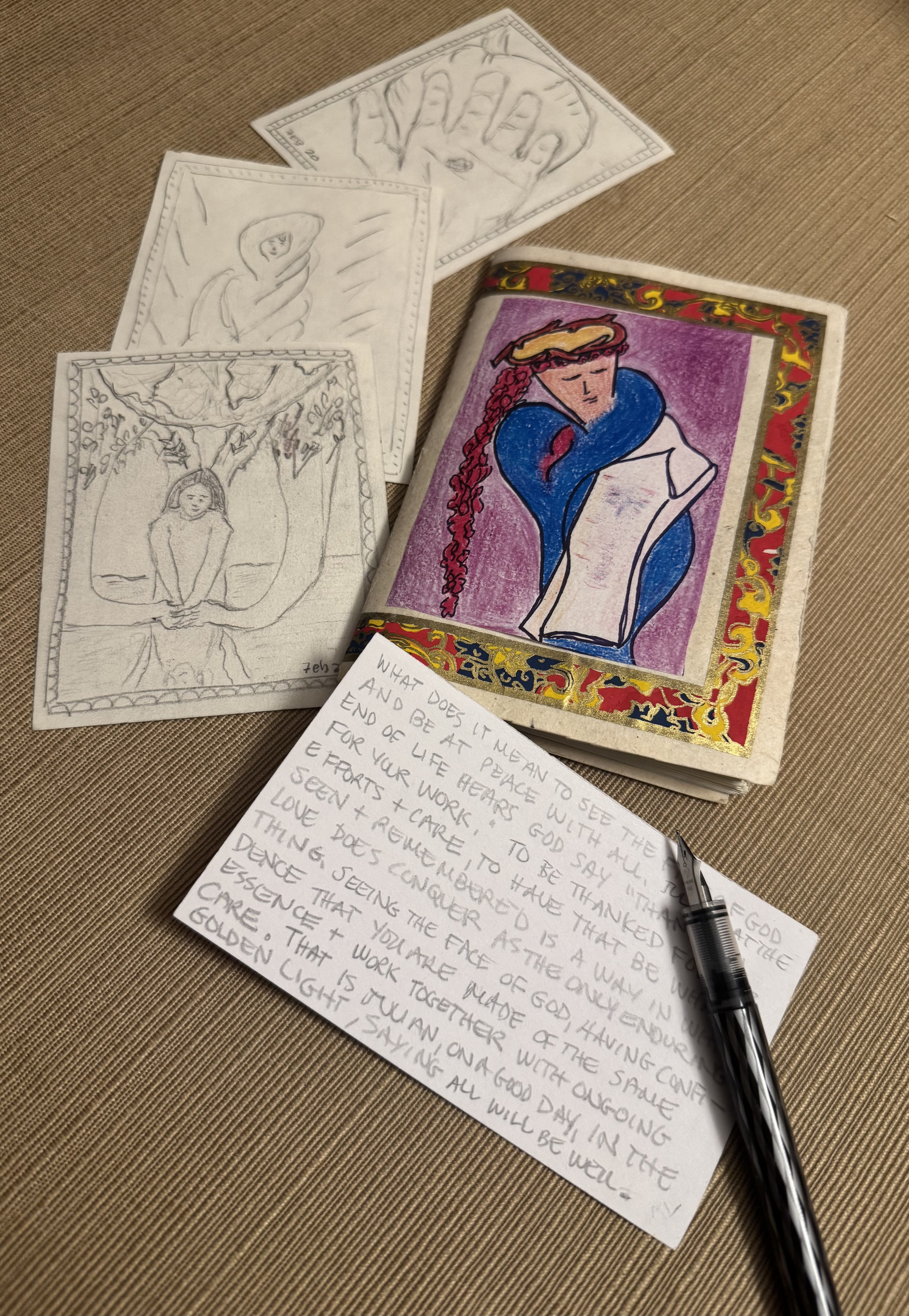
This book of morning reflections on the writings of Julian of Norwich taught me so much. Each day I meditated on a quotation, did a response drawing, and wrote a short reflection. Julian was born in the 14th Century, and lived a cloistered life of prayer and study. From the confines of her cell, she ruminated on the mystical visions of her youth, and provided spiritual guidance to community members and travelers. She wrote in a time of war, plague and social strife and is believed to be the first woman to be published in the English language. I hope that readers here, whether familiar with the writings of Julian of Norwich, or encountering the selected quotes for the first time, will see what I have shared as an invitation to their own creative contemplation and mindful, hopeful witness.
Category: Reading & Writing

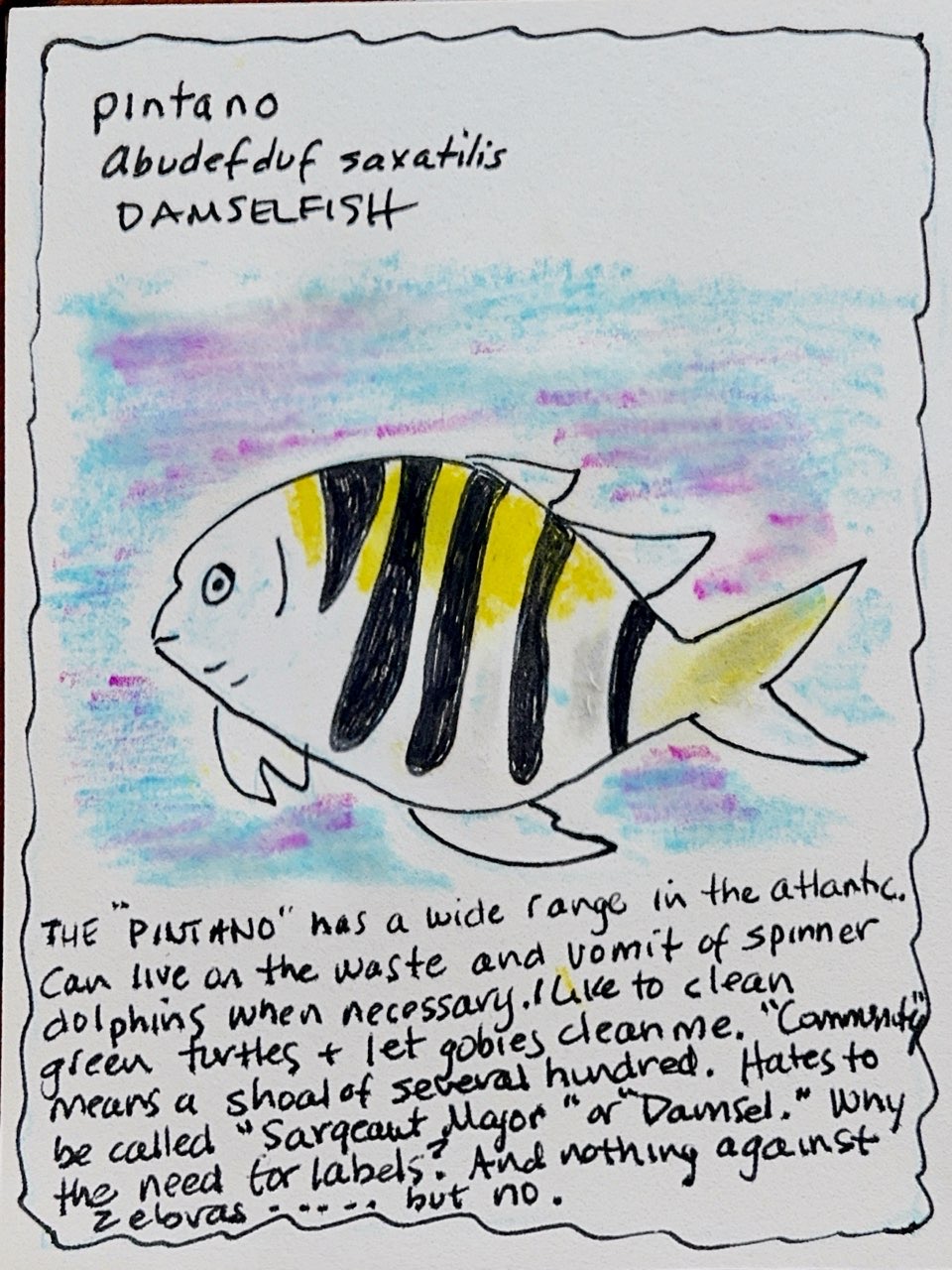
It was wonderful to visit St. Lucia in January. I stayed near the Anse Cochon cove on the south west coast. I spent my days reading, writing, swimming and snorkeling there on the beach. Each morning I sat with my coffee just after sunrise to draw a fish I had seen the day before. The fish made my daily journaling fun, fluid you could, and the morning drawing practice made my time with the fish more rewarding to. I learned the scientific names for the fish, and I tool time notice distinctions between similar species — colors, the shape of a fin, was there black dot? Being with fish, and recording it in this way, was a great way to spend a week, and taught me a few lessons that will continue to be useful when I leave these shores, and go back to other ways of being in the world. Here’s what abudeduf saxatilis had to say! You can look at my zine “Being with Fish” HERE.
I am so grateful to Professor Lynda Barry and my fellow travelers in the Fall 2024 course, THE UNTHINKABLE MIND. We drew with our eyes closed, we made comics, and we explored what images can do. During this period I became Lemon Drop, and she became me. My daily journals and approach to writing will never be the same! I’m sharing this zine, entitled “A Girl, a Flea and Reverie,” by Lemon Drop. It’s a portfolio from the class, and I hope it makes you want to choose a comics name for yourself, and draw with the free spirit and wild mind of a child. Let me know what you think!
Download PDF here: A Girl, A Flea and Reverie (two-page view option recommended)

Lemon Drop, The Unthinkable Mind, 2024
Presented at the Africaide 4W Celebration of the International Day of the Girl
October 9, 2021
Letter to a Girl —
There are so many girls to write to in our big, wonderful world. It’s a world that needs our care. But today I am writing to you, the girl who has lost someone to death. Maybe it was COVID19, war, or cancer. Or maybe it was some unimaginable absurd preventable thing, some big “if not for” that you are living with. Or maybe it was simply the end of a long life well-lived.
When we lose someone we love, we always lose a particular kind of love along with that – mother love, father love, grandmother love, grandfather love, the love of a sister, or brother or friend. Yes, love is love – but each kind is unique too. With the loss we face the truth that a person we cared for deeply must let go of having more life – life they wanted – and we have to carry on without the particular kind of love that they gave us. Sometimes, it feels like it will never come again.
But is it really lost? I want to be honest here, so I will say yes, and also no. Yes, because you can’t see them or hold them or touch them in real time the way you used to. That is something to grieve. But also no… because they are not really gone.
If they’re not gone, then where are they? Well, they are in you for one thing. Maybe you have their eyes, or their laugh. Or maybe you’ll be blessed with a wonderful dream where they visit you and give you a message…. something you needed to know, or something you wanted to hear them say one more time. There are also in you when you do the things they taught you … together, you throw a ball, make a tortilla, play the piano, plant a seed. They gave you all kinds of reasons to love and forgive. And these reasons still stand.
I hope you know you are loved and loveable just as you are. Especially when the noise of life can confuse that question.
I’m here, unknow and far away, caring somehow. Are you cold, hot, tired, lonely? Are you singing, working, laughing, hoping? I’m not sure.
But I do believe that there is a gentle wind that connects us all. It carries birds and butterflies, and, arguably, light and hope.
Wherever you are I hope you feel that wind, and that it touches you with the love that you lost. I hope it touches you today, maybe even now. Some remembrance, a sign, a gentle breeze — a warm one if you’re cold, and a cool one of you’re hot.
I hope that breeze touches you deeply, and you feel sure of the love that it carries.
With love,
Lori

Lori DiPrete Brown
Today I am honored to be invited to comment on “Transforming Leadership in Global Health” at the CUGH pre-conference session offered by Women in Global Health. I am looking forward to meeting new people and seeing old friends! It is a great way to get ready for International Women’s Day. I’ve been given two questions to think about- so I thought I would think out loud a bit here on my blog in preparation for the session.
“What is one piece of practical advice you would give to someone starting out?”
It’s hard to pick just one – there are so many practical things to be done! Learn to drive a stick? Learn to change a tire? Learn to speak three languages? Take a self-defense class? Always carry chocolate? Maybe you should buy that quick dry underwear and have the courage to travel with just two pairs… I have not yet done all of these things, and practicality is not my strongest suit. I am more of a dreamer with practical friends…. but maybe I can narrow things down to two essential, if not always practical, pieces of advice.
First, always pack a book.
And by that I mean make time for, brake for, reading and the arts. It is important to stay curious, take the perspective of others, keep learning, and hold space for the passions of your youth. In some ways that raw young being will always be your most authentic self. Remember her. This reading is a way to honor the roads you didn’t take — maybe that of a poet, or a painter or a comedian. (I know I have a rockstar inside, and yes, I let her out now and then…). The openness that results from this practice will enable you to let wonderful things happen in life and work
Everyone feels alone at times — on a team, during field work, forty-thousand feet in the air…. and women leaders are no exception. We feel alone, divided, overwhelmed, not up to the task. We carry an extra stone or two, and most of the water. Books can be friends who love you in these difficult moments. You can lose yourself in one, or find yourself in one, or write one yourself.
Second, always be yourself.
And continue to become yourself. Be brutally honest with yourself about who you are and who you are not. Be critical about your work, and use feminist approaches to help with that – develop embodied, dialogic, subversive and truth-telling practices. Smile and laugh and sing when you want — and please be stern and scowl freely too! And then try to be very gentle with yourself — I’ll even use the word tender — and go about the business of getting the work done. That’s what leadership is. Knowing what the work is, and getting it done. Be warned — if you are pleasing everyone you might not be doing very much…. you may have lost your edge, or you may be sacrificing the difficult truths in a way that is at odds with what transformative leadership should mean. Try to cultivate humility, persistence and hope along with some fierceness or fearlessness in yourself. It will be necessary and essential if we are going to create justice for women, foster human thriving, and ensure the survival of our earth herself.
“How would you catalyze change to create a better future?”
There are so many ways to make change. I don’t think there is one right way. Rather the future depends on everyone doing what they can, from where they are, and as who they are. While all the time cultivating trust in the world, despite the odds.
For me right now, leveraging the power of higher education for a better future feels powerful and possible and important. We have started doing this in a gender-informed way at the University of Wisconsin through a campus-wide, local to global, women and wellbeing initiative that we call 4W – Women and Wellbeing in Wisconsin and the World. Our mission is to make life better for women and make the world better for all. We focus on developing leaders, and we work to bring research to practice and practice to scale. It is a great model that can be implemented at Universities of any size. I think we are unique right now, but my dream is that this would become a very ordinary kind of program -business as usual – so that universities become safe places for women and everyone to grow and thrive and lead. I’d like to see Universities lead here, so that the many societal institutions that are failing women right now, in fact, failing everyone, can follow the example, and change, and make life better for all.

“Little Library” Shorewood Hills, WI
I love libraries in every way and I wish we did reality shows and documentaries about them — go to cities or small towns anywhere and you can find your people. Readers and seekers and escapists and children.
People being frugal — checking out instead of buying, people using the free computers to look up their ancestors or to try to find a job.
Librarians who happen to have seen a documentary about that question you have…. and children being read to. And, with all the ands and buts of needing to create more belonging and inclusion everywhere — libraries come closest to “everyone is welcome” than almost every public institution.
And the free speech is palpable — the books that do not agree with each other sit beside each other on the shelves so respectfully — all honoring what a library IS.
I have cried in libraries because of all this.
So don’t prompt me about libraries when I have so much to do today. Don’t get me started…. Gotta go but gonna sing in the car now… about libraries…..
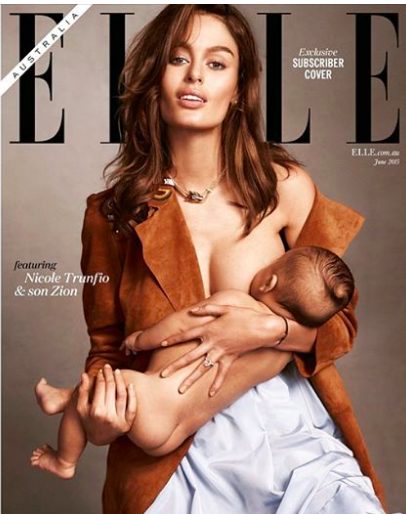
Love the intention here — However, based on 3 kids/3 years of breastfeeding experience in all kinds of places I am gonna suggest a few tweaks … Let’s put a diaper on that child. Also, you might want to lose the ultra suede — that is good for one wear and then it will be ruined by drops of breast milk or runny mustard colored ….
About the necklace — the child, very appropriately, is going to find that to be of visual and tactile interest and they are going to want to pull on it … Let’s swap that out for an attractive burp cloth. Note to new moms: it is okay if your hair is not combed.
Note to new moms: it is okay if your hair is not combed.
If you look carefully you’ll see that the baby has a hairdo? That can be done easily with vaseline I think — but definitely optional. Also sit on a comfortable chair if you can — be ready to look your baby in the eye and maybe sing a little.
Though I don’t recommend the pose in this photo, I want to reassure you that it is possible to empty the top rack of the dishwasher while breastfeeding if necessary.
Finally, and just so you know…if you look this hot when breastfeeding at home in the presence of your partner you are going to end up with another multitasking challenge on your hands…not a bad thing, but just make sure you are using contraception that allows for spontaneity so that you can space out the births in your beautiful growing family….
Breastfeeding is sacred. Amen.

Lauren Redniss, author of “Radioactive,” UW-Madison’s GO BIG READ will speak on campus on Monday, October 15th.
It was a great weekend to stay inside and read the 2012 UW-Madison Go Big Read, Radioactive, by Lauren Redniss. Put forth as a “Tale of Love and Fallout” that explores the lives and science of Marie and Pierre Curie, the book delivers on what is promised. Then it heats up and starts to glow, shedding quiet light on other themes, such as the nature of spiritual love, the way gender roles shape what aspects of ourselves the world allows us to express, the experience of parental loss and migration, the truth of war, and the way human genius simultaneously creates beauty, awe and the capacity for self-destruction.
Marie and Pierre fell in love with each other and science in a way that cannot be disentangled. Together they made careful measures with the sensitive instruments of physics, and spent years sorting through tons of rock to achieve their goals. They celebrated life with bike rides, adorning their handlebars with flowers in the springtime, and they enclosed themselves for long hours and years in a toxic laboratory environment that would hasten death for both of them. They made remarkable scientific discoveries, and they participated in seances (also studying them with the physical sciences) with the seekers of their day. They passed on a complex legacy to their children, who followed them to make significant contributions in the sciences. Does anyone feel ordinary yet?
Identifying the genre of a literary work is usually straightforward, but Radioactive defies categorization. Is it a children’s picture book, a science text, a biography, a philosophical treatise on ways of knowing, or a history book? Is it fact or fiction? Is it an entirely new genre — or simply an artsy scrapbook? While a case can be made for all of these labels, I would classify it as non-fiction. While it reads like a storybook, a closer look at the the narrative reveals that it is actually nothing more than a chain of of small verifiable truths. By creatively assembling the facts, and citing scientific fact, letters, Marie’s dissertation, newspapers and the scientific journals of the day, Redniss creates a truthful and poetic space for readers to explore the meaning of life, love and science.
I look forward to discussing the book with students and colleagues throughout the year. If you are in Madison, Wisconsin on Monday, October 15, 2012, you can hear Lauren Redniss talk about her work at 7:00pm in Varsity Hall, Union South. Admission is free and tickets are not required.
Half the Sky, the movie, just came out and can be seen at
Part 1-available till October 8th
http://video.pbs.org/video/2283557115Part 2-avalable till October 9th
http://video.pbs.org/video/2283558278

 Half the Sky, by Nicholas Kristof and Sheryl WuDunn documents the hard truths about being a woman on this planet. While some of us choose our spouses, share parenting, and become doctors or astronauts, many are stuck in a cycle of poverty and suffering that includes unfulfilled potential, maternal mortality, slavery and human trafficking, prostitution and survival sex, every kind of violence, and a lack of choice and safety in relation to their sexual and reproductive lives. Because I work with programs that address the health of women and children, people often ask me what I think of the book. Is all this really true? Did they get it right?
I have read the book three times and each time I am more impressed. In addition to portraying the lives of women with great dignity and respect, Kristof and WuDunn provide the reader with stories of resilience, cause for…
View original post 663 more words
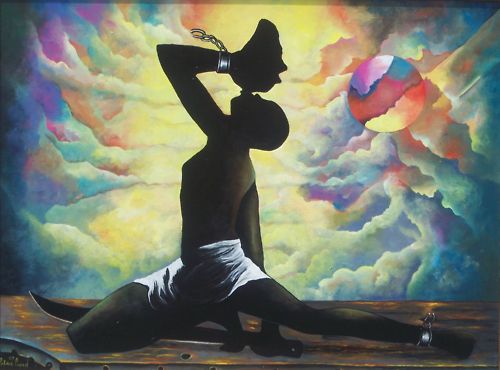 Haiti After the Quake begins with an image of Haiti rising, as it always has, to free itself from suffering and shackles, both real and metaphorical. How many people know that Haiti was the first country to abolish slavery, and that it’s national sculptural icon Neg Mawon (“the free man”) survived the quake and still blows into a conch to call others to freedom?
Today the University of Wisconsin welcomes Dr. Paul Farmer to its Distinguished Lecture Series, so it’s a good time to post a review of his most recent book, Haiti After the Earthquake. Many are familiar with Mountains beyond Mountains, Tracy Kidder’s award-winning account of Farmer’s work in Haiti. For those inspired by that book, I recommend reading some of Farmer’s own writing. Well-researched and meeting every academic bar, they are also written in an intelligent accessible voice that does not apologize for its passion or its bias –a preferential option for the poor, and all those who suffer or are voiceless. Titles include Pathologies of Power, Partner to the Poor, and Infections and Inequalities.
Farmer’s 2011 Haiti account is true to what he is and has been. He takes the reader with him through the days after the quake at an hour by hour pace, as he sees patients, tries to engage constructively in the policy development process, and even as he succumbs to fatigue, lying in bed rather than going to safe ground outdoors during strong aftershocks. Thankfully, he cannot resist weaving in Haiti’s history, and lessons from his experience in post-genocide Rwanda. The book does not have the flavor of distilled wisdom, it is too soon for that. Instead Farmer honestly walks us through complex issues, sharing his own questions with us, trying to imagine realistic scenarios of success, and, perhaps most importantly, channelling the Haitian spirit, insisting on hope as a moral imperative.
In addition to Farmer’s own story the book includes the voices of others who know and love Haiti. Nancy Dorsinville brings us close to Haiti and its evocative language as she recounts the various ways people named the cataclysmic event. The earthquake “tranbleman te,” that thing “bagay la, “ and finally “goudou goudou,” which needs no translation. One can hear the earth shake. Walking around the camps with Didi Bertrand Farmer, seeing her own daughter in the faces of girls who risk rape and abuse when fetching water or walking to the latrine, one is shaken from the protective distance we create between ourselves and disaster. It could be us, it could be our children, and in a very real sense, it actually is.
Those engaged with Haiti have become familiar with the term “Build Back Better.” Before reading this book I was uncomfortable with the chop chop of that — it seemed to celebrate erasure for the Haiti that was, in the name of progress. I worried that master plans would bulldoze local places and the small dreams of people who wanted to restore their own homes, streets, schools and churches. But the voices of Haitians that come through in the book (particularly in the chapter by Michele Montas Dominique, where she summarizes the Voice of the Voiceless project), seem to embrace this idea as a way of making meaning out of the loss, and, provided that they have a say in the plans and designs, it is something that gives them hope.
Haiti Afer the Earthquake is a collection of voices. People who have worked together for years, come together around a tragedy, and humbly try to record and make sense of it for the rest of us. These are wise people, people who, I suspect, think and pray together. The book is a first step toward learning what it means to accompany Haiti, to walk with those who suffer, and to be a healing force when we encounter brokenness in our world. Let’s build back better.


 Reflections