Category: Reading & Writing


Half the Sky, by Nicholas Kristof and Sheryl WuDunn  documents the hard truths about being a woman on this planet. While some of us choose our spouses, share parenting, and become doctors or astronauts, many are stuck in a cycle of poverty and suffering that includes unfulfilled potential, maternal mortality, slavery and human trafficking, prostitution and survival sex, every  kind of violence, and a lack of choice and safety in relation to their sexual and reproductive lives.  Because I work with programs that address the health of women and children, people often ask me what I think of the book.  Is all this really true?  Did they get it right?

I have read the book three times and each time I am more impressed.  In addition to portraying the lives of women with great dignity and respect, Kristof and WuDunn provide the reader with stories of resilience, cause for hope, and suggested  action that will make a difference.

The first time I read Half the Sky was just before Sheryl WuDunn came to Madison to speak about the book for our local Planned Parenthood chapter in 2011.  I sponsored a table with my neighbor and friend Joyce Bromley, and we decided to invite some of my global health graduate students to join us.  Sweta Shrestha, a “Madison girl” from Nepal,  Aaliya Rehman from Pakistan, Middleton’s own Roman Aydiko, originally from Ethiopia, and Chrstine Kithinji from Kenya.  The topics were difficult, but the evening felt like a celebration — these young women in my circle were saddened but not shocked by these realities. Empowered with education, they are hopeful about being leaders and making change.  As the crowd departed we found ourselves in a circle sharing stories.  Each of these women told of someone who had fought for her: an uncle who defied the family and took his bright young niece to school because he knew she could realize her dream of becoming a doctor, a mother who defied tradition and married for love (and she wore pants!), parents who braved the immigration journey to the US with their children, and a foreign sponsor who kept investing in a young African woman, by providing scholarship support.  All of these young women are leading international lives now, making a difference in public health work here in Madison, and staying engaged in  their home countries.  Sweta leads service learning programs for UW students in her native Nepal,  Roman is engaged in research and quality improvement in Ethiopia, Christine is building a clinic in her home town, and Aaliya, an obstetrician who is proud of her Pashtun origins, is now in Pakistan working to improve maternal mortality.

This fall I assigned the book to my global health honors class for first year students.  “The book made me tremble,” one student told me.  Rereading the book through her eyes somehow made what was already real to me more real.  The raw facts lingered, and the numbers and the truth of the stories sunk in.  Is this really true? I realized it would be almost impossible to tell a false story about the oppression of women and girls, because everything  you can imagine is already happening to a girl–just about every girl you could make up is actually out there.

The subject of the book came up with again with students in my global public health class this spring.  We  discussed the book over coffee before class, and someone asked if I would blog about it.  So I gave it another read through yet another lens.  This is a class where we focus on action: What is the problem? What are the root causes? What works? How can we close the gap between the world we are in and the world we want to be in?  That is our public health mantra, and Half the Sky did not let us down.

Educating women, creating livelihoods through mirco-enterprise, providing health care… these things work.  At the end of the book Kirstof and WuDunn suggest 4 ways to support the  women and girls all over the world who are trying to change their own lives.  It will only take about 10 minutes and it probably will cost you less than you spend on dog food or coffee in a month.

1) Make a people to people microlending loan  (www.globalgiving.org or www.kiva.org).

2) Sponsor a girl (Plan International or Womenfor Women International).

3) Mmonitor news about global women’s issues through www.womensenews.org or www.worldpulse.com.

4) Become a citizen advocate at  the Care Action Network (CAN) www.care.org/getinvolved/advocacy/index.asp

I hope people will read the book and get involved.  As hard as it is to stare down what is happening to girls in our world, change is possible, and women and girls are surviving and rebuilding their lives.

There is a movie based on the book coming soon.  See trailer at:  http://www.halftheskymovement.org/

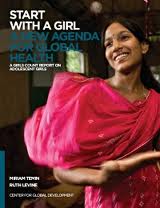
What will the world look like in 2015? And how can we make it a place that offers sustainable health and well-being for everyone?  At the Annual Symposium of the UW-Madison Global Health Institute, Ruth Levine described the burgeoning youthful population that is projected to dominate the global south as an asset rather than a liability, provided that we make the right investments, and provided that we “Start with a Girl.”

Levine identified the years from 12 to 14 as a crucial time in a girl’s life, where risks to health and well-being can increase, and her choices, her world, can become increasingly narrow.  If secondary schooling is withheld, a girl is confined to the home, child marriage is encouraged, and she is exposed to abuse and exploitation, she is destined to be trapped in a life of poverty and suffering.  On the other hand, for about a dollar a day, we can provide girls with community-based supported, health services designed to meet their needs, schooling and economic opportunities that can help us realize human rights for girls, and, at the same time,  benefit from a demographic dividend that will enhance the well-being of everyone.  See the keynote presentation here:   http://videos.med.wisc.edu/videos/39524

If you would like to know more about this effort you can read the complete report,  Start with a Girl: A New Agenda for Global Health by Miriam Temin and Ruth Levine, and review related news and resources at:  http://www.cgdev.org/content/publications/detail/1422899.

Further, you can see what change looks like for individual girls, and join the movement to change things for girls, at  The Girl Effect, where there are stories about girls from a number of countries and lots of ideas about how to get involved.

THIS VIDEO EXPLAINS THE GIRL EFFECT IN SIMPLE WORDS AND MUSIC:  The Girl Effect

What about boys, you might be asking yourself?  They don’t experience the same risks and narrowing of choice and agency that girls do, but their needs are important also.  This movement is about extending education and opportunities to girls alongside, not instead of, boys.  To really make change we will have to work with girls and boys, men and women, so that the rights of girls and women are respected, and they are allowed to achieve their potential.

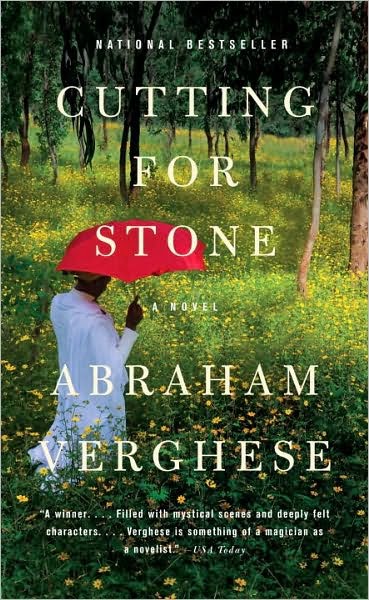
On my recent trip to Ethiopia, I decided to reread Cutting for Stone by Ethiopian-American surgeon Abraham Verghese.  I first read it when it came out in 2009, a beautiful novel that  also provided a window into Ethiopia’s health system.  Now I wanted to test it out on its home turf.

From Addis I was less focused on the ways in which the book could “take me there,” since I was already “there,” working in hospitals, walking the streets, meeting people who had lived through the challenging times that Verghese described.  I wasn’t troubled by the license that Verghese had taken with some of the factual details relating to Ethiopian history or “Missing” Hospital itself…. He had told us it was fiction.  A fiction writer myself, I understood that sometimes you have to make some stuff up or move things around a bit to tell an authentic story. Would Verghese’s story and its messages about life and place and love and fate ring true?  For me, that was a more interesting question than whether his story corresponded to the material and chronological facts.

Reading from my hotel room in Ethiopia, where the hall light streamed into my room all night and the dogs began barking just before dawn,  I realized how much this novel transcends it’s particular setting, and speaks to so many of us who have been shaped by immigration, by separation, and by living in ways that leaves us with more than one place that we can plausibly call home.

Verghese tells us the story of twin boys, with two fathers, two mothers, two countries, and one woman they both love.   We all have so many possible lives and possible selves, and the story of Marion and Shiva his twin reminds us that it is hard to contain all we can be in one life and place, and it may be even harder to contain it in two.

The boys are attached a birth, share a bed, and then are separated by miles, oceans, time, revolution, and their own differences. The story unfolds through the eyes of Marion, as he tries to understand and reconstruct the truth of his past.  What happened?  And why?  There is always more than one answer — a double, an opposite, a twin.  The boys have two parents who raise them, and two others who gave them life.  Their birthmother, Sister Mary Joseph Praise, lived a prayerful life of submissive service, and, we are led to believe, also experienced the spiritual passion of Theresa of Avila.  Thomas Stone, their biological father, also had a divided life, on the one hand a focused, tireless and dutiful surgeon, and on the other a man possessed by binges of excess.

As I read in Addis I realized that many of the diaspora Ethiopians that I am working also have two lives and two places that are home.  I too, am divided, both the person who wants to go home, and the person who wants to stay.  Can we live these double lives, or does one of our selves have to sacrifice itself for the other?  Cutting for Stone asks this question and, as might be expected, shows that there is more than one answer.

For me the special thing about this book was not the fact that “it takes you there.”  In fact, when I look for scenes that capture what is like to walk the streets of Addis or be immersed in the setting, I find that they are few.  This made me realize that while I thought I was experiencing this place in a close up and personal way, Verghese was writing from a more intimate perspective, a surgical distance where the background fades as the human heart is dissected in ways that reveal truths common to all.  Verghese finds the truth and healing of our brokenness through the act of fiction, because, as he puts it,  “where silk and steel fail, story must succeed.”

Sitting at the Java Den at University and Mills before class,  I was not sure what to expect.  Students from PHS 370 were invited to drop in to meet me, connect with each other, and talk about local to global perspectives on public health.  I was armed with a computer, a short novel, and the New York Times in case no one showed.  But I did not even get to read one headline….

Maggie arrived first wanting to explore how to make global health work a part of her life.  Relatively new to UW, she is shifting from a political science focus to a public health focus.  She told us a bit about her work in Bulgaria where she worked with the Roma population.  this video portrays the challenges that this ethnic group faces.

Abby had been on the Uganda Field experience led by John Ferrick and James Ntambe and she has done a lot of coursework related to public health and health disparities.   Pascale who joined us later will participate in the same Uganda program next year.   Laura, a global health certificate student,  joined us and shared that she will be working with Araceli Alonso on the Health by Motorbike program this summer.

Tahiya joined later in the hour and very generously shared stories about her summer in Bangladesh where she worked in the Geneva Camp focusing on children with disabilities.  The camp, established in 1972 to meet the needs of Pakistani’s who were still in Bangladesh after the transition, is now a crowded multi-generational community.  The video focuses on the health risks for children in the camp.

Liz, who is doing an  honors project for the class, hopes to consider homelessness in Madison in a global context through case studies or oral histories.  Stay tuned as she may be willing to share her project in  class or discussion section!

I blog as a reflective practice and to share information and experiences with my students, colleagues and friends. Some of the topics that I will cover this semester include my upcoming global health work in Tanzania in March — I will miss a few classes but will make up for it with some blog posts!  Also, I am working with a group of students who are planning to go to Ecuador to do service learning in a community where I have worked for the past six years.  I am going to “back blog” for them from my journals, so I can share some of my favorite memories and photos with them  and introduce them to the community where they will work.  I am going to cover campus events like lectures by Ruth Levine, who is coming on March 14th, to our annual Global Health Symposium.

I am also planning to do some global health-related book reviews.  Coming soon Is Cutting for Stone, by Abraham Verghese, which takes place in Ethiopia.  I am also reading Haiti after the Earthquake by Paul Farmer.  I will review A Sand County Alamanac, by Aldo Leopold, to explore the implications of a his “land ethic” for a new global health ethic.  Finally, I will reread one of my all time favorites, Cry of the Earth, Cry of the Poor, by Leonardo Boff.   I wonder if it will seem as good as it did when it changed my life many years ago….

Please feel free to comment on this post or make suggestions for future topics!

Meeting author Sonia Nazario during her recent visit to UW Madison

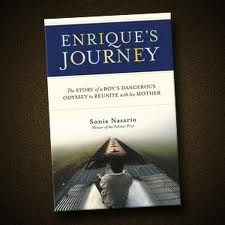
Since I  had worked with children in highly vulnerable situations in Honduras, the same country where Enrique’s journey begins, I was especially  interested to meet Sonia Nazario, the author of  Enrique’s Journey, when she came to UW-Madison on October 27th to talk about her book, the 2011 GO BIG READ.

Born to immigrant parents in Madison, Wisconsin (!) Nazario came of age in the dirty war in Argentina, and has spent many years of her life covering social issues as a journalist.   I felt humbled by the extent to which Sonia put herself at risk so that she could accurately tell the harrowing story of Enrique’s journey from Honduras to the United States to find his mother.  As she explained the many safeguards she put in place before she travelled by bus across dangerous borders, spent time in communities rife with social and political tensions, and rode on the tops of trains (students, please don’t try this at home!),  it was clear that she had been brave and selfless. She was also honest and self-critical about some of the harder truths about fly-on-the-wall journalism  –it is your job to watch the suffering play out, and, unless someone is in imminent danger, you offer no help.

The next day I met Sonia at a luncheon with a group of my students who were reading the book for an honors seminar. When I told  her that I had lived in Honduras and worked with orphans for two years, she wanted to know what I thought about children like Enrique.  What should we do?   It impressed me that several years after publication, this prize-winning author, who had already done such thorough research, was still at work on the story, asking questions rather than giving answers, wanting to get it more right.  She asked me to make public-health oriented suggestions for the “how to help” section on the Enrique’s Journey site http://www.enriquesjourney.com/howtohelp.html.  There are already some great ideas there, and I am looking forward to working with my students to contribute more!

I did not expect Enrique’s story to move me as it did. The book was covering terrain that I had lived, in a place that I once knew well.   The story of his family of origin was sad and authentically told, but familiar to me.  Like Sonia, I was aware of and disturbed by the family life patterns that are emerging with our global economy, in which domestic workers from many countries come to sweep floors and rock babies in the US, so they can send money home.  But the visceral realities of Enrique’s journey and crossing stopped me cold. The hunger and thirst, the raw cruelties and occasional kindness, the feeling of being hunted. Even I, having lived in Central America, did not know the extent to which children are wandering alone, preyed upon, in places that we are unable to even police.

Sonia Nazario has taken us on Enrique’s journey so that we can understanding the suffering of immigrant youth who make the crossing the way he did. It would be a mistake, however, to read this book as a background piece on Central American immigrants in a “this is their story” kind of way.  Such a reading would be a misuse of a well-written, well-researched story and a denial of the human complexity behind every story.  Enrique and his family are not a prototypes — they are people.  It would be an over-simplification to assert that mothers who are in the US working have all been forced to choose between raising their kids in garbage dumps and migrating  for work. It would be naive not to recognize that it is possible to both run toward love and flee from abandonment at the same time, and I think that is what happened with Enrique.  Some immigrants “go north” because they are desperate, some do it because they are dreamers, and some are both of these at once.   To address the suffering portrayed in Enrique’s story we have to address the root causes of the problem.  While poverty is a primary driver of migration and should be addressed,  substance abuse, unintended pregnancy, family violence, unequal status of women, and the breakdown of the extended family all impacted the lives of Enrique and Lourdes.

Enrique’s Journey, which Nazario describes as the story of one boy, one mother, and one train, is a call to action on behalf of all children in this situation.  I hope that for students at UW-Madison, this Go Big Read is the beginning of another kind of  journey, where they both act on what they learned from this book, and continue to read and study and live in ways that allow them to continue growing in their understanding of issues related to the well-being of children everywhere.

To blog or not to blog?  For me that wasn’t even a question!  As a life long diarist, I believed that the best place for my private thoughts was  a notebook tucked between my mattresses.  Blogging seemed narcissistic –all that living out loud seemed to contradict everything I believed about the inward life, the importance of the unobserved moment, the value of words in ink on paper–just one original that can be hidden or crumpled or burned.  You can even write in code, which I did for the better part of 1979….

Why would anyone trade the raw authenticity of journaling for the prettified blog, that revises as it records, and distorts as it edits. I held my travel journals close to my chest…. Blogging seemed like a recipe for self-deception and vainglory.  (Would I ever say vainglory in a journal?)

So why am I here now, blogging, imagining you?

It began when (Oh God I just found myself making something up … luckily I caught myself and deleted it) a colleague asked me to blog at a Global Health Conference over a year ago (see September 2010 posts).    I didn’t dislike what I wrote, and I found that a number of my students had followed and enjoyed the blog… I did a mildly clever one where I pretended I met Bono, and people got it.  I found that I was more focused in the conference sessions because I knew I had to blog about them.  And when I nervously pressed “publish” for the first time, I realized that accountability comes along with the admittedly “selfy” act of blogging.  I began to see that there is discipline and courage here too.

During the course of the following year, as I wrote in my journal about my global health work in Ethiopia, Ecuador, and Mexico, it occured to me that some of those entries, as well as older travel journals and  more local reflections, might be worth sharing if I had a blog. I was learning through the writing, challenging myself, and sensing life more fully.  I realized that if I could muster up the courage to let others read and write along, my writing had the potential to create a voice and space for the people and places and issues that I care deeply about.

Can I combine the rush of blogging with the introspection and raw truth of my journals?  Probably not.  But I can try.  I can share my experiences and honest reflections with family, friends, students, and even readers who I don’t know…  I can try to blog like there’s nobody watching.  Of course I know the reader is there, and because of that I will polish and edit and censor a bit (not a bad thing, actually),  but I hope always to write  (almost split that infinitive, but no, not here!) with my whole self, whatever that means and whatever the cost.

We all carry so many identities, and we don’t always realize the cost of keeping them separate and expressing them selectively.    As a writer-teacher-learner-mentor-mother-wife-daughter-sister-friend-seeker, I want to explore what it means to speak from the core of my whole self.  In spite of the fact that my three children have forbidden me to blog about their lives (and I will honor that within reason), the well-being of the world’s children, beginning with my own, but by no means ending with them, is my life compass.  I blog to better understand what this all means.  I have this foggy notion that if I try to blog out what I believe I may actually behave better….

I hope that I can be a witness to beauty and joy, and I hope I am kind and generous in my words.  I may also get angry about suffering or injustice, and speak uncomfortable truths about myself and my world.

In case you are trying to remember the rest of that quote about dancing, and you don’t already own the T-shirt, here is the full text:

“You’ve gotta’ dance like there’s nobody watching,
Love like you’ll never be hurt,
Sing like there’s nobody listening,
And live like it’s heaven on earth.
(And speak from the heart to be heard.)”
-William W. Purkey

This is a great read by a UW Madison professor!

This intimate and richly contextualized study of medical education in Malawi paints a vivid picture of how western medicine is being taught, internalized, adapted and owned by African medical students and physicians. Wendland begins by describing the role that medicine has played in Malawi’s history; the detailed and nuanced picture provides the reader with a deep understanding of a particular African reality, as well a framework for viewing the role of medicine in other African settings and globally. Wendland follows the students from their villages and and preparatory schools, through their academic training, and on to their first days of service in African hospitals. This journey provides insight into how the students experience the promise of medicine, as well as it’s shortcomings, and also shows how they bring their own history, culture, and life experience to their medical practice. The work is further enhanced by first person narratives of the medical students recorded during their training and early years of practice, as well as several case studies of patients that illustrate the fullness and power of viewing health and disease through an anthropological lens. Wendland’s evocative prose and unflinching self-awareness complement these other elements, making “a heart for the work,” an example of medical anthropology at its best. — L. DiPrete Brown, October 24, 2010