Category: Around the World & Back Again


UW Madison Alumna Sweta Shrestha and I visited the Hamlin Fistula Hospital on behalf of our students on Friday, December 2, 2011.

The fistula ward was not what I expected.  For one thing, I thought it would smell.  I had prepared myself to smile, stand close, show no sign of revulsion.  I did not want to add one iota to the pain or shame that these women (many were young girls, actually) had experienced,  having been shunned by their communities, where they were often relegated to an outdoor shack because of the odor and  incontinence related to fistulas the were caused by obstructed labor.

A series of paintings that hang in one of the entrance halls to the hospital (signed Dawit B.), tell the typical story of how these women got to this place. I could not help but think of the stations of the cross as the story unfolded, beginning with a very young bride and early pregnancy, during which time her in-laws expect her to do the heavy work like hauling wood, carrying water and grinding grain. Fasting might also be practiced, for all or part of the pregnancy, further compromising health.  Then, if labor is obstructed (small stature places a woman at higher risk) and no medical care is sought, these young women can suffer for 3-9 days, with a still birth the likely outcome in 96% of the cases.  Another common outcome is a hole in the bladder wall (fistula) that can leave the woman incontinent.  Her husband is likely to leave her.  Then his parents send her home to her own family, where she will sleep outside because of the leaking and odor.

There are 9000 new cases of fistula every year in Ethiopia, according to Dr. Gordon Williams, who kindly gave us the tour, and this year 2500 got care through this and affiliated fistula hospitals.  While they can accommodate  4000 patients/year (only enough to meet 1/2 the need) this capacity is not realized because the women who need care are isolated.  They do not know that other women are living with the same problem.  They do not know that there is a cure.   The journey of the “Fistula Pilgrims,” a term that  founders Reg and Catherine Hamlin used to refer to these women who came to them for help, is portrayed in a moving award-winning  documentary called “A Walk to Beautiful” (see trailer at http://www.walktobeautiful.com/) which tells the story of 5 women who make the journey to the Hamlin Fistula Hospital to seek care.

Fistula Patient –photo from Hamlin Fistula Hospital Website

When women arrive at the hospital they are given a clean gown and a brightly colored patchwork blanket that will be theirs to keep.  It provides warmth and comfort, and  later it is a reminder to them to tell others about the care and cure that is possible for women who suffer from obstetric fistulas. These blankets are donated by people who care from a distance all over the world.  I saw women in their beds, in the clean well-lit ward, urine bags in place, patches of color everywhere. They were at rest, comfortable, some smiling, a few reading (either because they are just learning or because they already had rudimentary skills). There is a garden on the grounds, and a “house” where they can go for a traditional coffee ceremony, and also hear taped stories in their own languages (since many speak languages other than Amharic).

Surgery will cure most of these women, but 25% of patients will need to try other strategies or continue to live with the incontinence.  To provide choices for women who can’t go home, the Hospital has also developed a rehabilitation center that includes a farm, a simple restaurant, and other income generating activities.   It was wonderful — and a lesson in what beauty truly is– to witness the healing of  these women, and to see them treated with such dignity and care.

Women with their blankets relax in the Garden at the Hamlin Fistula Hospital (from official website)

Of course I wish I could do more than just walk through the ward, smiling and saying “salaam.”  And thanks to my students I can ! Sweta Shrestha and I made this visit on behalf of our freshman honors global health students, who had learned about fistula and watched “A Walk to Beautiful” as part of a film series that Sweta has been leading for the past year.  The students  wanted to go beyond merely studying the problem — they wanted to do something personal for the women, to send a message of hope and care across the world.   Dr. Williams assured us that blankets and/or financial donations from UW-Madison students would be welcome, and we made sure we got the specs before we left.

For people from the Madison area: the UW-Madison students are organizing a showing of the film Walk to Beautiful  on campus on February 5th, 2012 (time and location TBD — check back here).   We hope to discuss the film, learn more about obstetric fistula, and make some blankets to send to Ethiopia.  There will be materials to work with at the event, but if you knit or crochet feel free to make some squares (10″x10″) in advance and bring them to the film showing.  We will patch things together and deliver them to the Hospital. The brighter the colors the better!   This is another way to celebrate and participate in the Wisconsin without Borders initiative.
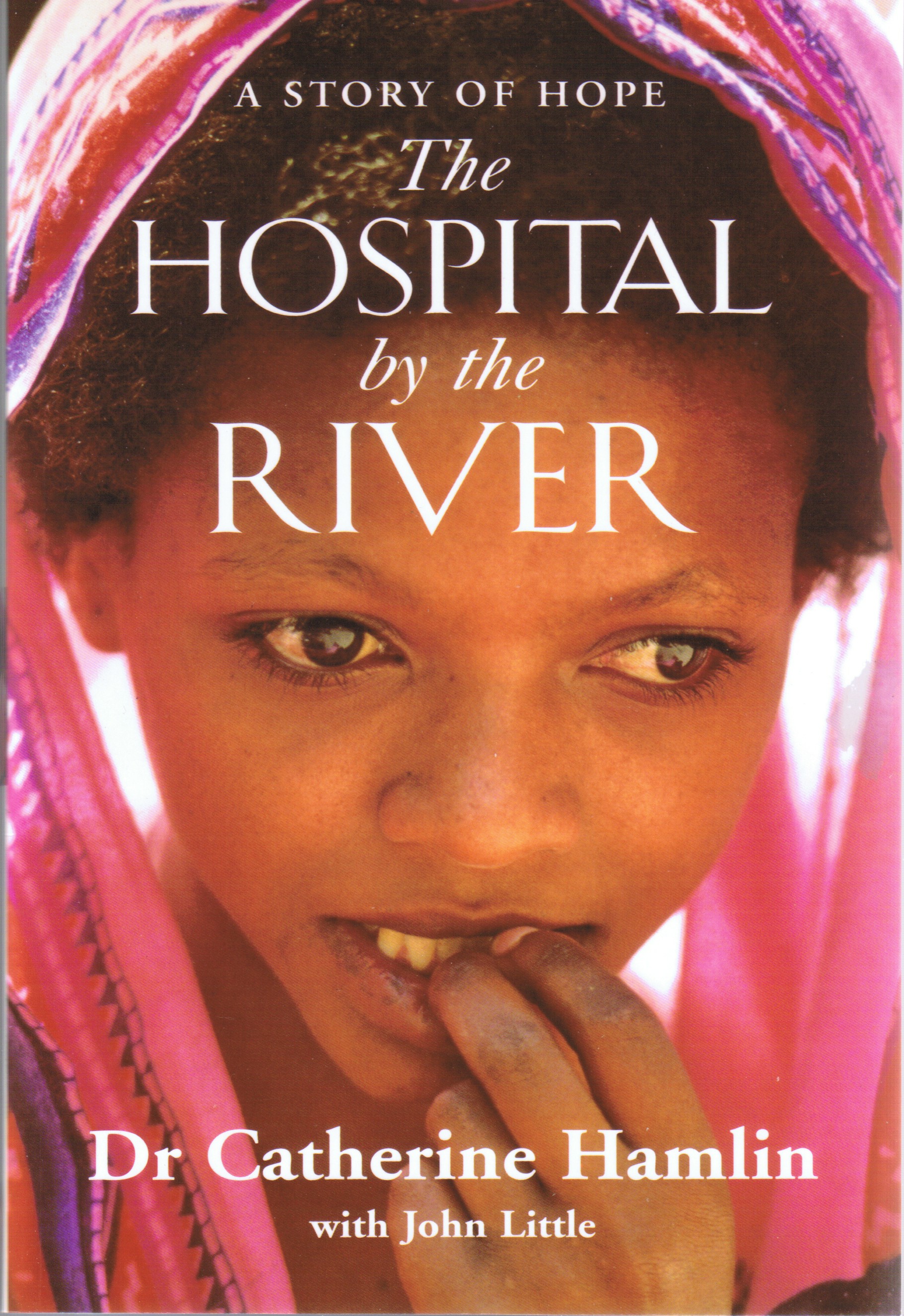
More information about obstetric fistula and the Hamlin Fistula Hospital in Addis Ababa can be found at: http://www.hamlinfistula.org/index.html . Also, there is a chapter devoted to this site and work in a book I highly recommend,  Half the Sky, by Nicholas Krustof and Sheryl WuDunn (see Chapter 6: Maternal Mortality: One Woman a Minute, p. 93-102).   Dr. Catherine Hamlin (with John Little) has also written a book entitled, The Hospital by the River: A Story of Hope.  It is a straightforward narration of her life and work, and a very interesting read.

Would you like to go to the ICASA 2011 conference in Ethiopia?  It’s not too late…..

It was such a privilege for me to be at the conference and hear presentations from researchers from around the world.   This post is a gateway to that meeting for my students and readers.  I am providing a summary of some of the bolder plenary remarks, as well as highlights from some sessions that I attended.  Most importantly there is a link that will allow readers to browse the full program and all the presentations.

Challenging words from Stephen Lewis about the Global Fund: Lewis described the decrease in donor funding of the Global Fund as appalling and attributed especially bad behavior to the EU.  Dismissing economic causes, he characterized these decisions as valuing women and children in Europe and North American more than women and children in Africa, favoring fighter jets over human beings, and protecting defense budgets instead of millions of human lives.

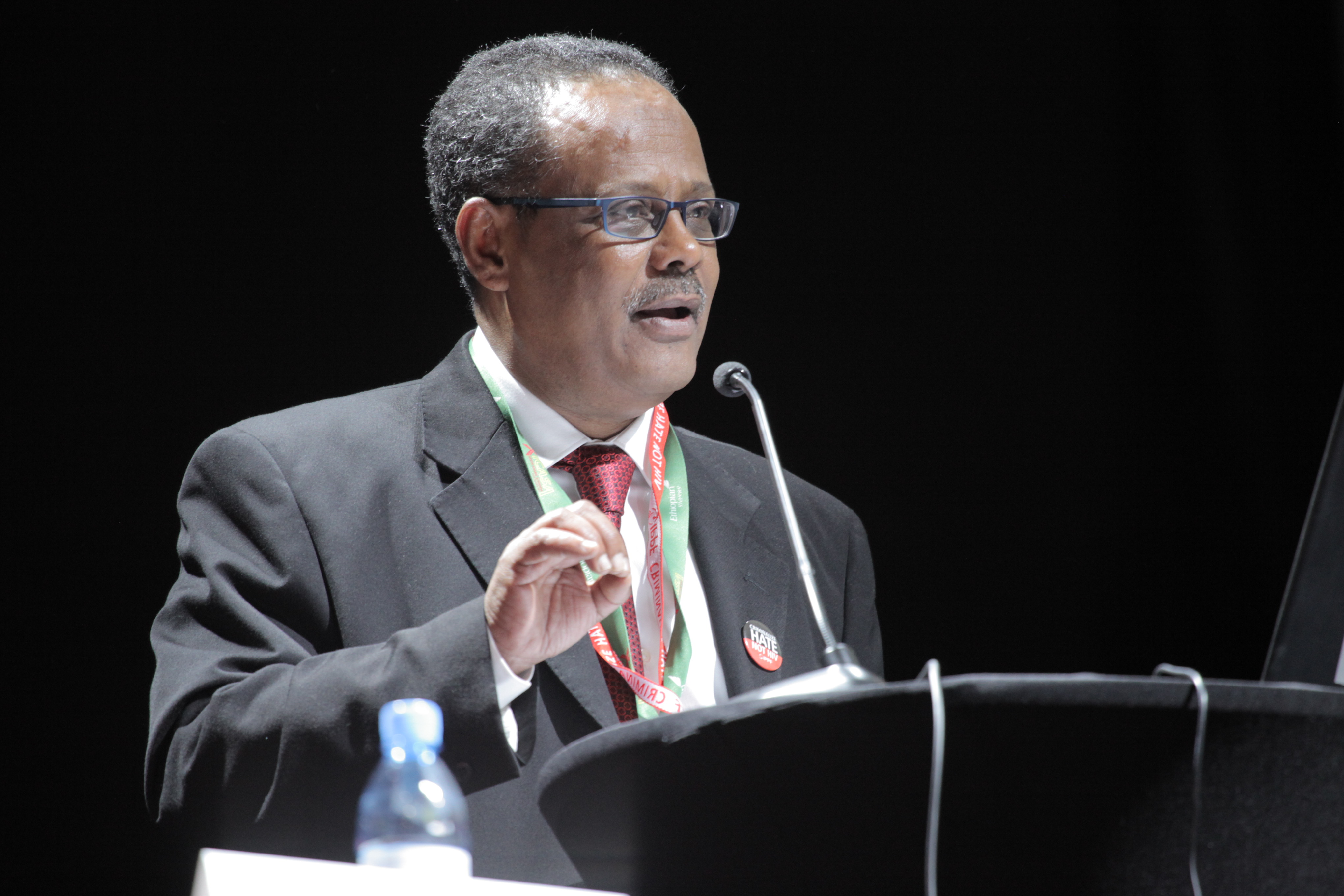
Tewodros Melesse was a brave Ethiopian voice for dignity and rights for all:  Melesse emphasized the sexual and reproductive rights of women, children, adolescents and LGBT persons.  Speaking out against stigma and discrimination of all kinds,  he reminded the crowd that  there had to be respect for, and room for, differences of opinion. Melesse words were appreciated by many, especially session co-chair, Miriam Were of Kenya, who dubbed him an honorary woman for his advocacy and willingness to speak out.

The conference papers addressed HIV prevention, testing, treatment(s), co-infection (especially TB), prevention of mother to child transmission, and challenges in reaching and caring for highly vulnerable populations.  Participants reported on many aspects of the diverse and complex epidemic, which Peter Piot described as many epidemics, rather than one.  Researchers presented evidence about the feasibility of lifelong ARV care, male circumcision, microbicides, and care for discordant couples.  I chose to attend sessions that focused on health systems and multi-sector approaches, since that is the emphasis of the Global Health Institute at the University of Wisconsin-Madison.

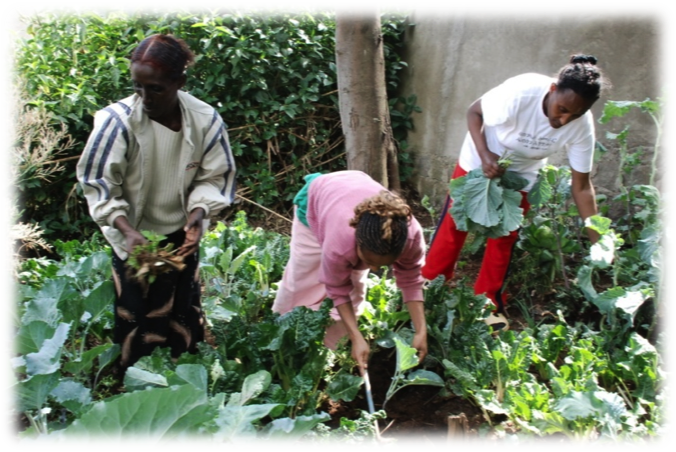
From ICASA presentation by Fana Abay for Enda-Ethiopia

HIV and Agriculture:  This session, entitled promoting livelihoods for HIV/AIDS affected communities, featured rigorous research, much of it in Ethiopia, related to sustainable agriculture and economic empowerment.  Since I come from a community where local food and urban gardens and farmers markets have gained a lot of attention, I felt at home as I heard about strategies for urban populations that included bio-intensive gardening and small-scale dairy efforts through south-based NGOs.  This study documented improved CD4 counts!  A second study, which reported improved nutritional status, focused on low input gardens and local food production that increased access to eggs, vegetables, and beans. Another study explored the relationship between HIV status and land use, finding that 43% of HIV affected households have lands that they are not able to cultivate.  Strategies that address basic food security alleviate hunger, and they do so much more.  They can enhance the effectiveness of treatment, enable HIV positive persons to be strong enough to work their land, and they can contribute to reduction in transmission by reducing the incidence of transactional sex (girls having sex for money because they are desperate for food).  Community-based HIV efforts are increasingly  going beyond health care services to address hunger.

HIV and Non-Communicable Diseases (NCDs):  There has been much talk in the last few years that vertical programs like those that address HIV/AIDS could  contribute to overall health system strengthening, because of overflow benefits, such as the development of general clinical and management skills,  and the potential for more rapid horizontal integration of services. This session made the case that drug supply and quality assurance systems developed for ARVs could make it easier to develop similar systems for NCDs.  While insulin and asthma inhalers are expensive, many of the drugs needed to treat NCDs are affordable.  Presenters also stated that the MDGs neglect non-communicable diseases — and HIV care and monitoring fail to use the opportunity to detect NCDs, even thought HIV treatment likely increases susceptibility to some NCDs. With modest adaptations, HIV testing facilities could be adapted to test for diabetes, cholesterol, and BMI, and early diagnosis in the context of HIV care and monitoring would be possible.  Presenters also made the case that the trajectory of HIV care was similar to care for people living with NCDs. There is a similar focus on early diagnosis, continuity and multi-disciplinary, family centered care, as well as referral, self-management, and community linkages.  Therefore, the headway made in HIV care could be leveraged for more rapid and effective scale-up of care for non-communicable conditions.

 You can access and learn from the ICASA presentations and proceedings at the link below.  All the presentations are there. To browse the program and find presentations that interest you, scroll down toward bottom left and click on ICASA program book or ICASA pocket program.  Note the date, room and last name author and presentation title.  Then go to the folder and look in the room where the presentation took place for the file with the author and title that you noted (most are power points).

http://www.icasa2011addis.org/media-center/presentations

Regarding this blog site:  To receive  these “weekly and then some” global health blog posts via email, please click on the follow button at the top left.  No registration is required.

Zero new infections, Zero AIDS-related deaths, and Zero discrimination.  On December 1st, World AIDS Day, while these goals were being explicitly discussed in various fora around the world,  I was in a hospital in Addis Ababa working with colleagues from Ethiopia and Tanzania to develop plans to improve healthcare quality.  We mentioned World AIDS Day, but we spent most of the time talking about concrete changes we could make for trauma patients in local hospitals, for clients in local health centers who need HIV testing, for patients who need pain relief.  For me, working for tangible change against the backdrop of big inspiring ideas, was the perfect way to mark the day.

A few days later I found myself engaged in a different way.    I headed down Bole Road in Addis Ababa toward the 16th Annual Conference on AIDS and STIs in Africa (ICASA 2011), part of a throng of 1o,000 people who all, in one way or another, were part of the fight against AIDS.  Today we were coming together to share 1000 scientific papers and 175 workshops, and to imagine how to create an AIDS free generation.  We would be celebrating the successes of the last 10 years, including the facts that 32 countries have stabilized the epidemic,  22 countries have reduced new infections by >25%, and countries like Botswana are leading the way with universal access to care and virtual elimination of mother to child transmission of AIDS.  Kenya is leading in important ways also, with the establishment of tribunals to assure rights and address stigma and discrimination.

We followed the sound of drums emanating from the main hall of the Millennium Conference Center, where many political and public health leaders were on the agenda.  In the final hours before the event it was rumored that former President  George Bush would be making an appearance…

… and he did.  Acknowledged for his courage as a first responder to the call for care for people with AIDS,  and praised for the establishment of PEPFAR,  a program which (in spite of its imperfections) has dramatically changed the landscape for people with AIDS,  George Bush was greeted with a standing ovation by the predominantly African crowd.

Did I stand up myself you may be wondering?  Well, first I should disclose the I am a life-long Democrat.  I consider myself open-minded and I care most about integrity and competence. I would vote Republican if the right candidate came along..but my bi-partisan credentials are weak.  I have never actually pushed the button….

I should also say that I am kind of  persnickety about standing ovations.   I think they should be rare, and I save them for near perfect performance.  The abstinence only campaign was definitely a wrong note that I could not overlook….

When Bush took the podium, and nearly everyone stood up, those who did not kept their hands in their laps, looking incredulous, uncomfortable, or just plain still.  There was a lone shout of “what about Iraq.”  I myself stayed seated.  As I listened to Bush from the audience I was a bit surprised by what I heard.  “In order to advance as a society we must focus on the needs of women.”   “We can’t retreat from the need in the world.”  “Isolationism is always a mistake.”  “Even when economic times are difficult we have to stand against human suffering and make saving lives a priority.”  A cynical voice in my head asked if Bush would be willing to go on tour in the US with these messages. But the mood in the room told me that this was bigger than partisan politics. Bush was saying the right things, and he was not triumphal.  He gave credit to both parties for what the US began in 2003 and continues to do under the Obama administration.  He went on to describe the new pink ribbon/red ribbon campaign, a global effort to use the capacities developed in the fight against AIDS to address cervical cancer, which can be detected easily, and if caught early, can often be treated in a clinical setting with a very simply procedure.  It is interesting to me (though really not surprising!)  that all the ex-presidents, in one way another, have discovered that global health is the thing that really matters.

I felt  privileged to be part of this assembly, moved by what those in the room had accomplished, by what PEPFAR (and other efforts!) had meant for people living with AIDS, and even by Bush himself.  At the end of his remarks people rose again.  Yes, I remained seated, but I clapped my hands until the end, until they tingled a bit, and I meant it.

Today we visited an NGO that is making a difference in the lives of children with programs that provide food, health care, education, protection, psychosocial support and, perhaps most importantly,  income generating activities that address poverty.

Beza Lehiwot Ethiopia, which loosely means “giving for life,” serves people who live in or near the Mercato, Africa’s largest market in Addis Ababa.  Because the Mercato is such a place of exchange and concentrated population (and the location of truck stops, bars and the bus station) it is also a place where there is a lot of poverty and high rates of HIV/AIDS.  The  unpaved streets are lined with food stands and shops made of corrugated metal sheets.   One shop was adorned with bunches of bananas, and a side of beef hung in another.  Vendors were carrying all of goods to and fro.  One man had a large wooden bench strapped on his back, while another carried a stack of red plastic chairs that towered over the crowd.  Donkeys laden with sacks of grain made their way around our taxi and toward the center of the market.  Our destination, the Beza Lehiwot Ethiopia “headquarters”  is made up of a series of rooms around a courtyard, and houses a feeding center called My Father’s Kitchen, as well as a small day care center.

The purpose of our visit (myself,  Sweta Shrestha, Kate Konkle and Laura Laskofski) was to meet with women from the vocational program that teaches women to sew, then launches them into small businesses though provision of a sewing machine that they pay off over time.  We wanted to explore whether this group might become a partner for the emerging Wisconsin without Borders Marketplace.  I am hoping that UW-Madison students can serve and learn with this community in a number of ways that enhance health and well-being, including support for the microenterprise.

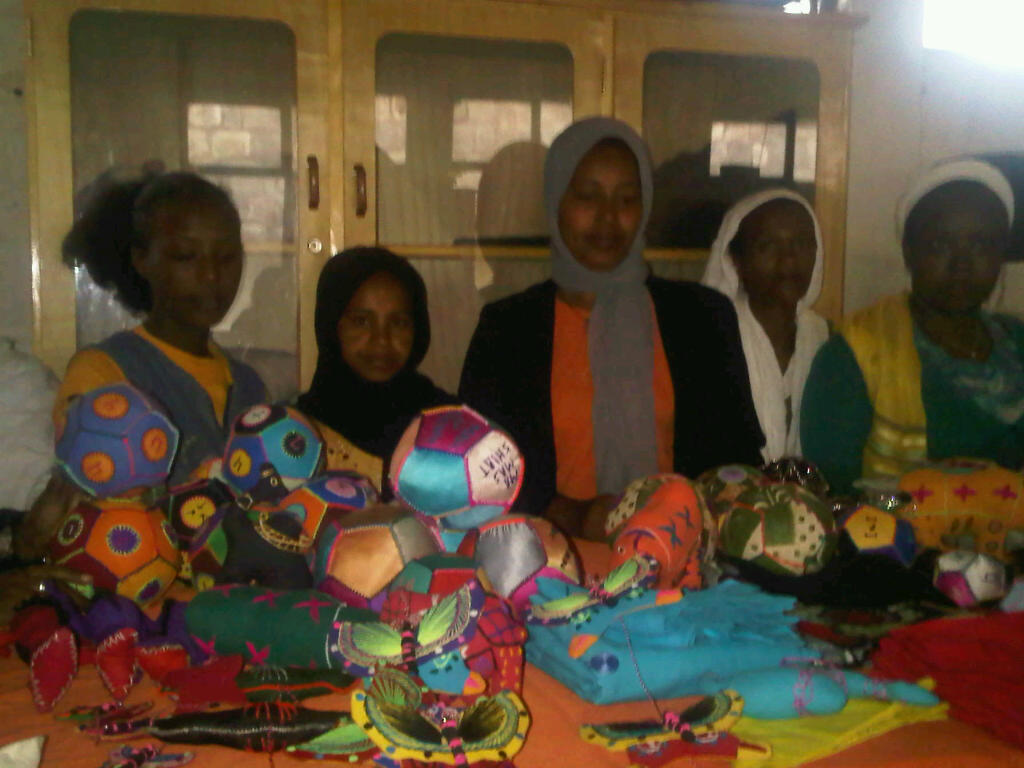
We met the group  in the local school where they have  a workroom. There were about 10 women, along with 4-5 children, clustered around their sewing machines (the non-electric foot pump kind!), some doing handsewing while they waited.  We shared awkward translated introductions, but generally smiles prevailed, as we told them about ourselves what we were interested in, and asked them ithey would like to sell some of their products in Wisconsin!  They told us a bit about their lives, both before and after the program,  and then we made our way to the table where their goods were displayed.  Brightly colored napkins, embroidered pillow covers, pieced balls with the amharic alphabet on them, and small stuffed animals — alligators, hippos, an elephant.  They also earn money by making uniforms for local schools.

We asked the women if we could take a group photo to display it with the products, and we asked them what they would like us to tell the buyers about them and their work.  “Our vision is to support our children and send them to school,” said one woman, who went on to explain that she has been earning 1000 birr (about $60) a month through the sewing work. Previously she had been washing clothes to try to make ends meet.   “Tell them we are very thankful,” said another, “we do need markets, the government gives us some opportunities but this additional one will help us to get enough.”  Another woman only smiled and held my hands for a moment, but she spoke up later on behalf of the group when it came time to discuss how ordering and shipping would work.  The women also sold us sample items to bring bring back to Wisconsin as the basis for an order that we will place.

I am so grateful to Dereje Shiferaw of Save the Children and Dawit Gultneh of Beza Lehiwot Ethiopia for sharing their work with us.  After working at the policy level on programs for orphans and vulnerable children for the past 4 years, this short visit meant so much to me, because  I was able to see that change is really happening for some of the people we wanted to touch.   Stop the world I want to get on!  That is what I was thinking.  I would love to spend more time here, be partner and friend to these communities, as they change their lives.  I very much hope I will be able to stay engaged through my students and supporters of University of Wisconsin without Borders.  Any takers?

One of the wonderful things about this visit has been the chance to taste many traditional Ethiopian dishes.   During the season just before Ethiopian Orthodox Christmas many people fast (refraining from eating meat and dairy) which means that there are wonderful vegetarian dishes to try.  Our lunch at a delicious local restaurant included chick peas, lentils, green beans, chopped greens, and ingera, the local flat bread, made of teff, a local grain.

I was amazed at the complex flavors and textures that could be coaxed out of a variety of preparations of lentil and other legumes.  It is hard to understand why this is called fasting, unless you know that Ethiopians love meat, and one traditional favorite is raw beef.

Coming from our Thanksgiving feast last Thursday, to this plentiful traditional meal soon after, I can’t help but think about the close proximity of abundance and want in our world.  While I thought about the hunger and bouts of famine experienced in Ethiopia when I was at my family table, I think about it in a different way, here, at this table.  Closer to the hunger, but also and paradoxically further away,  I am responding no better because of the closeness.

There are so many ways to think about and understand food scarcity in our world:  issues of basic justice,  issues related to land use, technological challenges related to efficient cultivation and storage of food, the challenges of food distrubution,  and the need for food policy and collective action that recognizes that everyone has a right to share in our world’s abundance.

Do I give money to the women and children who tug at my sleeve, tap on the window of our taxi,  putting their hands to their mouths, showing me their hunger?  Does it encourage a behavior that demeans them further, or does it meet a basic need in the absence of any kind of safety net? I don’t know the answer and my responses reflect my confusion.  Donate to an NGO that might help them, support a local student who is working on agricultural development, look at them, look away, pray, have a second helping because it tastes so good.  There is no way to order these actions in a way that hides the double truths of my life.

But I do know one true thing that must be said:  If these same people were able to live their traditions in a healthy and whole way,  and I was the same wandering traveller that I am here now,  they would be offering me a place at their table.  They would smile at me and feed me first, using the same hand gesture to show me how to eat from this world’s common plate.

New technology for the Emergency Room is now in use.

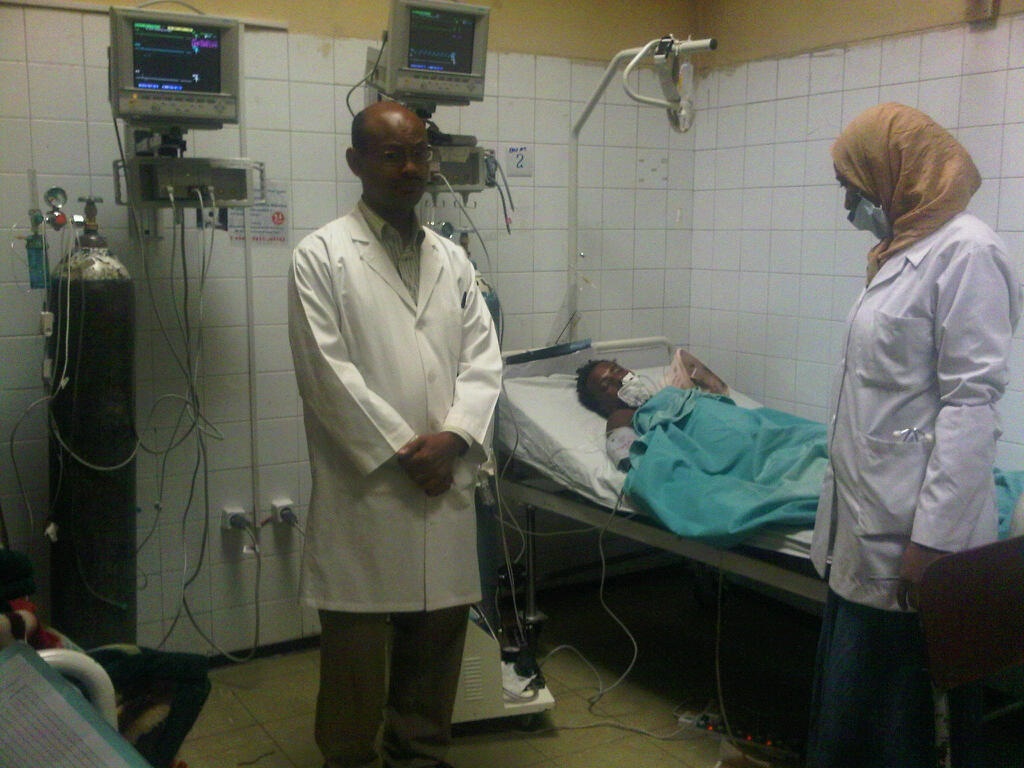
I first visited Tikur Anbessa Hospital one year ago to work with colleagues from the hospital and Addis Ababa University.  My partners are exchange fellows with UW-Madison, and we are working together to develop healthcare quality improvement efforts in the hospital.  These are some of the most talented and well-trained health professionals  in the country, and I have had the privilege of  collaborating with them through shared work and study in both Madison and Addis for the past two years.

The Hospital, whose name means Black Lion in English, is a large public hospital and faces the problems you would expect in a sprawling African city with a high rate of traffic accidents.  This hospital receives those trauma patients, and serves as a referral hospital for the more difficult cases seen in other hospitals, ranging from emergency obstetrics, to pediatrics, to multi-drug resistant tuberculosis to HIV/AIDS, to advanced cancers.  So just about everything is happening here….

There are visible changes since my last visit.  Last year the pediatric emergency ward was really in disrepair and creating very challenging con!ditions for health care providers, patients and their caretakers.  There was talk that a new pediatric  was in the works.  As several people described it to me,  I looked at that patch of ground they were pointing at, trying to imagine the new building, and worrying that this “six month” project might take years…. Well, the good news is it did not take years!  I peered into the windows this afternoon!  It is nearly finished with the ribbon cutting soon (maybe this week?) and patients will be moved from the temporary ward early in 2012.

A 24 hour pharmacy is now in place in the ER.

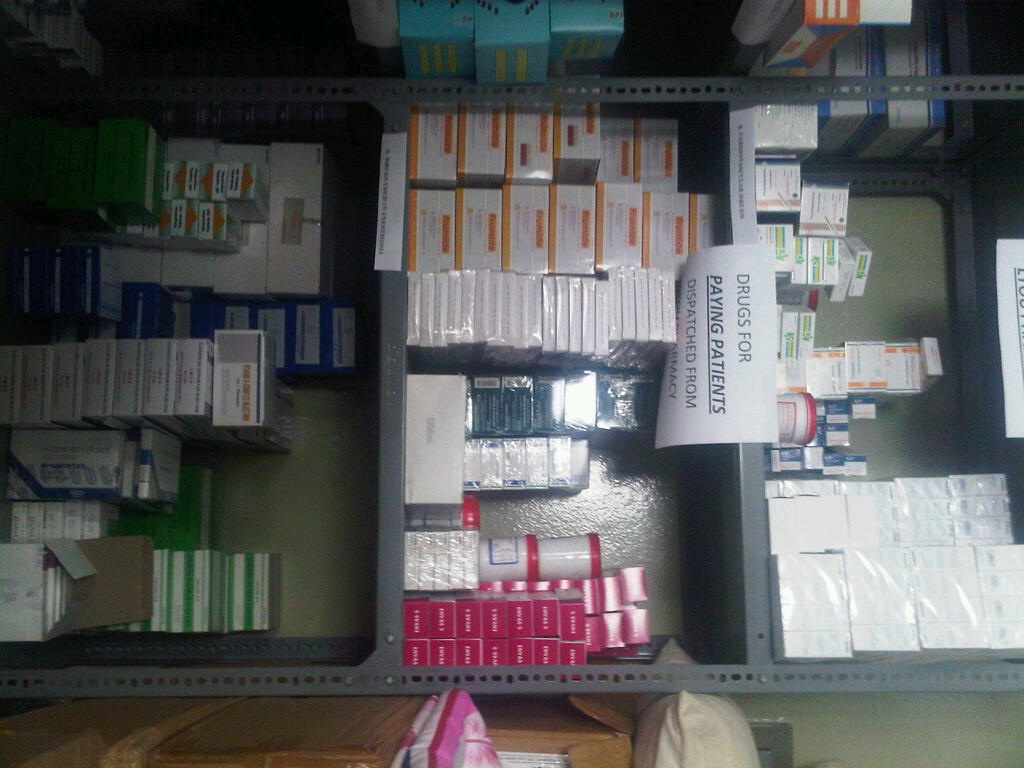
The other wonderful development was hearing about how the QI program is moving forward and maturing.  There was no building to point to, but as I sat at the table with my colleagues, who shared their successes and honest appraisal of the things that had not worked, and how they would keep trying new strategies,  I realized that the reality of what they had  “built,” terms of improved care was just as impressive.  They have developed and implemented a functional triage system and are sharing it with other hospitals.  They have made huge strides in infection control.  While we can’t see the cases of infection that have been prevented (always a problem for successful prevention programs!),  the cleanliness is evident on the wards in the adult emergency room, and plans are in place to replicate this in the new pediatric emergency ward.  They are also improving drug distribution in the hospital (imagine yourself in one of the beds and then think more effective treatment and better pain management), and are improving a number of registration systems that will lay the foundation for better information for case management and planning at the ward and hospital level.  In addition to all the projects, they have developed their own capacity to train others and, appropriate to their role as a national teaching hospital,  they are looking toward sharing experience and skills with other hospitals around the country.

One of the really special aspects of this project is that it is a Twinning Program, (see www.twinningagainstAIDS.org),  which means that we work through mutual partnerships and exchange.  It is  really joyful to walk the grounds of the hospital, and see the familiar faces of the fellows who have shared experiences with us in Madison.  In addition to being part of the valuable medical exchange,  we have walked the Lakeshore Path together, and some have visited my home.  During one visit the  fellows experienced snow, and another visit coincided perfectly with the peak of tulip season, so we skipped out of class to visit a local tulip garden!  This week  I am on the other side of the Twinning the equation– in my visits to Ethiopia I have begun to experience the beauty and hospitality and incredible history of this country, and I hope to return many times myself, and with my family.

Everyone gets their daily fix of hope and inspiration in a different way I guess, but for me today it came from revisiting this hospital, and seeing what is needed, what is happening, and what is possible.  It was a visceral  reminder to me that small changes matter. Perhaps we don’t have to develop complex   plans  to  “scale up change.”  I don’t want to scrap that idea entirely because it is the  topic of the talk I am supposed to give at the ICASA Conference next week (!), but I am beginning to believe that the most important thing we can do is to let the reality and possibility of the tangible changes that are within our reach capture our imaginations, befriend us, get out of control, and enable us to work together to change the world around us.

I will be heading off to Ethiopia the day after Thanksgiving to do some teaching for the American International Health Alliance (AIHA).  That should be an interesting exchange related to quality improvement in health care, and I will be working with partners from Ethiopia.

I am also going to attend the 16th Annual Conference on AIDS and STDS in Africa (ICASA).  I”ll be involved in two sessions, one about quality of care and one about care for orphans and vulnerable children. I expect to learn a lot about HIV/AIDS and the most current issues and challenges.  (See ICASA website http://www.icasa2011addis.org).

While in Addis I have also arranged to visit some sites related to my work with Save the Children.  I’d like to identify a community to participate in the Wisconsin Without Borders Marketplace.  The hope is that we can support a community micro-enterprise effort designed to benefit vulnerable children (due to AIDS or other causes) by buying and reselling their products — scarves, jewlery, baskets — these are some of the crafts that I expect to find.

A few friends and students have suggested that I cover my field work and the conference on my blog www.globalhealthreflections.wordpress.com  so that I can share what I am learning with the UW community, especially our growing community of global health students. Please feel free to visit and see my posts about previous trips to Ethiopia.  And sign up to follow the blog if you want to get updates by email!

On September 22nd, after 3 years of writing about it, talking about it, and trying to walk the talk, my UW-Madison colleagues and I launched our global service learning program, Wisconsin Without Borders.  What’s the big deal, some might say. Aren’t their already Doctors without Borders, and Engineers without Borders?  The answer is yes.  There are also teachers, lawyers, architects, nurses, sociologists, builders and acupuncturists. I had planned to end this post with the idea of starting a Clowns without Borders, but they are already active, spreading laughter and joy.  And the Knitters without Borders are making blankets and sweaters and sharing their dyeing and design techniques. I tried everything to find a new idea, but struck out again and again….Bloggers, Dentists, Geeks, Monks…they are all out there, without borders.  I stopped playing fair when I found a web reference to Mariachi without Borders! Cynically, I searched for Fence Makers without Borders. That would reveal the hypocrisy, show that the term was losing its meaning, would it not?  But the Without Borders world held, there are no Fence Makers without Borders, at least not yet….

Why do so many of us want a Life without Borders? What are we trying to say about ourselves?  Perhaps simply that we are open to the world.  We like to travel.  We want to make a positive difference in the world, to be part of the solution, at least for a moment.  But there is some kind of poetry at work here also. The phrase evokes the wild beating heart, a sense of freedom, sunlight, a loosening of chains.  It expresses a desire for union with people who are different from us, it says we are willing to risk ourselves to explore the differences, celebrate them, and watch them dissolve.

Even now, when there is so much need for healing in our own communities, my students and colleagues and I are finding a lot of support for the idea that reaching beyond the boundaries of our state is both a duty and a privilege.   Our students can be global leaders, they can act both locally and globally to promote justice, human flourishing, and care of the earth.  Our event featured 13 projects from around Wisconsin and the world that are inspired by the “Without Borders”  spirit.  Posters can be viewed at: http://centerforglobalhealth.wisc.edu/389.htm

You can see my brief Intro Remarks Explaining Wisconsin Without Borders  (Hi Mom!):

www.youtube.com/user/MorgridgeCPS#p/u/14/QnbZNOoO-SU

Also, see one of our student leaders, Megan Hall, talk about our Women’s Health and Microenterprise Program in Ecuador:

http://www.youtube.com/user/MorgridgeCPS#p/u/13/cmiTyv5HtHM

The program also featured remarks by John and Tasha Morgridge, who have generously supported The Morgidge Center for Public Service for the past 15 years, and Bob and Sara Rothschild, who presented their work in Botswana, where they are working with communities to build public libraries. Their presentations and the entire event can be viewed at http://www.youtube.com/user/MorgridgeCPS

To blog or not to blog?  For me that wasn’t even a question!  As a life long diarist, I believed that the best place for my private thoughts was  a notebook tucked between my mattresses.  Blogging seemed narcissistic –all that living out loud seemed to contradict everything I believed about the inward life, the importance of the unobserved moment, the value of words in ink on paper–just one original that can be hidden or crumpled or burned.  You can even write in code, which I did for the better part of 1979….

Why would anyone trade the raw authenticity of journaling for the prettified blog, that revises as it records, and distorts as it edits. I held my travel journals close to my chest…. Blogging seemed like a recipe for self-deception and vainglory.  (Would I ever say vainglory in a journal?)

So why am I here now, blogging, imagining you?

It began when (Oh God I just found myself making something up … luckily I caught myself and deleted it) a colleague asked me to blog at a Global Health Conference over a year ago (see September 2010 posts).    I didn’t dislike what I wrote, and I found that a number of my students had followed and enjoyed the blog… I did a mildly clever one where I pretended I met Bono, and people got it.  I found that I was more focused in the conference sessions because I knew I had to blog about them.  And when I nervously pressed “publish” for the first time, I realized that accountability comes along with the admittedly “selfy” act of blogging.  I began to see that there is discipline and courage here too.

During the course of the following year, as I wrote in my journal about my global health work in Ethiopia, Ecuador, and Mexico, it occured to me that some of those entries, as well as older travel journals and  more local reflections, might be worth sharing if I had a blog. I was learning through the writing, challenging myself, and sensing life more fully.  I realized that if I could muster up the courage to let others read and write along, my writing had the potential to create a voice and space for the people and places and issues that I care deeply about.

Can I combine the rush of blogging with the introspection and raw truth of my journals?  Probably not.  But I can try.  I can share my experiences and honest reflections with family, friends, students, and even readers who I don’t know…  I can try to blog like there’s nobody watching.  Of course I know the reader is there, and because of that I will polish and edit and censor a bit (not a bad thing, actually),  but I hope always to write  (almost split that infinitive, but no, not here!) with my whole self, whatever that means and whatever the cost.

We all carry so many identities, and we don’t always realize the cost of keeping them separate and expressing them selectively.    As a writer-teacher-learner-mentor-mother-wife-daughter-sister-friend-seeker, I want to explore what it means to speak from the core of my whole self.  In spite of the fact that my three children have forbidden me to blog about their lives (and I will honor that within reason), the well-being of the world’s children, beginning with my own, but by no means ending with them, is my life compass.  I blog to better understand what this all means.  I have this foggy notion that if I try to blog out what I believe I may actually behave better….

I hope that I can be a witness to beauty and joy, and I hope I am kind and generous in my words.  I may also get angry about suffering or injustice, and speak uncomfortable truths about myself and my world.

In case you are trying to remember the rest of that quote about dancing, and you don’t already own the T-shirt, here is the full text:

“You’ve gotta’ dance like there’s nobody watching,
Love like you’ll never be hurt,
Sing like there’s nobody listening,
And live like it’s heaven on earth.
(And speak from the heart to be heard.)”
-William W. Purkey

NCDs: The Silent Killer in Low-Income Countries

Don’t smoke.  Drink in moderation.  Eat right.  Exercise….  Many of us have, at one time or another, written such messages on a post-it note and stuck them to the bathroom mirror…but what just happened at the UN Summit on NCDs is bigger.  This was only the second time a UN summit addressed a health topic, the first topic was HIV/AIDS, and now this second summit addressed non-communicable disease.  The meeting achieved broad consensus that we must address these “big 4” causes of NCDs,  and laid out priorities and strategies.  It also described what  global NCD partnerships might look like –shared learning rather than large-scale donor funding from rich countries to poorer ones.  Some participants were disappointed that the meeting fell short of defining targets, indicators or criteria for progress.

This CSIS video summarizes the meeting well, featuring Nils Daulaire,  Director of the Office of Global Health Affairs at HHS,  Ambassador Ebrahim Rasool  (South Africa), and Medtronics Senior Executive, Trevor Gunn.http://bit.ly/pZP8ti

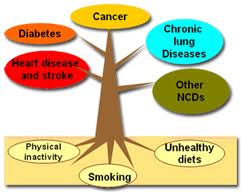
The resolution, which was passed at the summit,  is actually a great read!  http://bit.ly/qmouea.  It gives an overview of the global epidemiology of non-communicable diseases, discusses causes, advocates a whole of government approach (South Africa, in particular is walking this talk) and gives a concrete sense of what good policy might look like.  It recognizes the need for health system strengthening, and the global importance of anti-tobacco efforts (like smoke free workplaces and cessation initiatives that use text messaging), and it includes guidance about food systems, advertising, healthy environments.  It’s all there, and I have a feeling that it will be as challenging to implement this agenda in the US as in some of the lower-income settings.  The global effort will target  cardiovascular disease, cancer, respiratory illness and diabetes, focusing on four drivers — tobacco, alcohol abuse, poor diet, and physical inactivity.  There was and will continue to be tension and debate around balancing prevention  and treatment.  The CDC will serve as the point organization in defining this along with WHO the FDA,  NIH and others.

In attendance at this high level meeting was Dr. Jim Cleary, an international expert on pain policy, and the UW-Madison Global Health Institute’s Special Advisor for NCDs.  See his blog at  http://painpolicy.wordpress.com/.  In conversations at UW-Madison, Jim has challenged us all to think comprehensively about care for NCDs,  and remember that the lifetime death rate for human populations is 100% and holding steady!  Everyone dies, therefore, in addition to thinking about prevention, we must also think about what it means to have a healthy death, and that means compassionate care and pain management for all.   This one is for you Jim———>