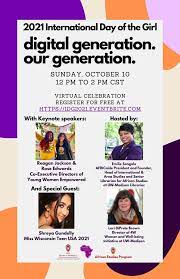
Presented at the Africaide 4W Celebration of the International Day of the Girl
October 9, 2021
Letter to a Girl —
There are so many girls to write to in our big, wonderful world. It’s a world that needs our care. But today I am writing to you, the girl who has lost someone to death. Maybe it was COVID19, war, or cancer. Or maybe it was some unimaginable absurd preventable thing, some big “if not for” that you are living with. Or maybe it was simply the end of a long life well-lived.
When we lose someone we love, we always lose a particular kind of love along with that – mother love, father love, grandmother love, grandfather love, the love of a sister, or brother or friend. Yes, love is love – but each kind is unique too. With the loss we face the truth that a person we cared for deeply must let go of having more life – life they wanted – and we have to carry on without the particular kind of love that they gave us. Sometimes, it feels like it will never come again.
But is it really lost? I want to be honest here, so I will say yes, and also no. Yes, because you can’t see them or hold them or touch them in real time the way you used to. That is something to grieve. But also no… because they are not really gone.
If they’re not gone, then where are they? Well, they are in you for one thing. Maybe you have their eyes, or their laugh. Or maybe you’ll be blessed with a wonderful dream where they visit you and give you a message…. something you needed to know, or something you wanted to hear them say one more time. There are also in you when you do the things they taught you … together, you throw a ball, make a tortilla, play the piano, plant a seed. They gave you all kinds of reasons to love and forgive. And these reasons still stand.
I hope you know you are loved and loveable just as you are. Especially when the noise of life can confuse that question.
I’m here, unknow and far away, caring somehow. Are you cold, hot, tired, lonely? Are you singing, working, laughing, hoping? I’m not sure.
But I do believe that there is a gentle wind that connects us all. It carries birds and butterflies, and, arguably, light and hope.
Wherever you are I hope you feel that wind, and that it touches you with the love that you lost. I hope it touches you today, maybe even now. Some remembrance, a sign, a gentle breeze — a warm one if you’re cold, and a cool one of you’re hot.
I hope that breeze touches you deeply, and you feel sure of the love that it carries.
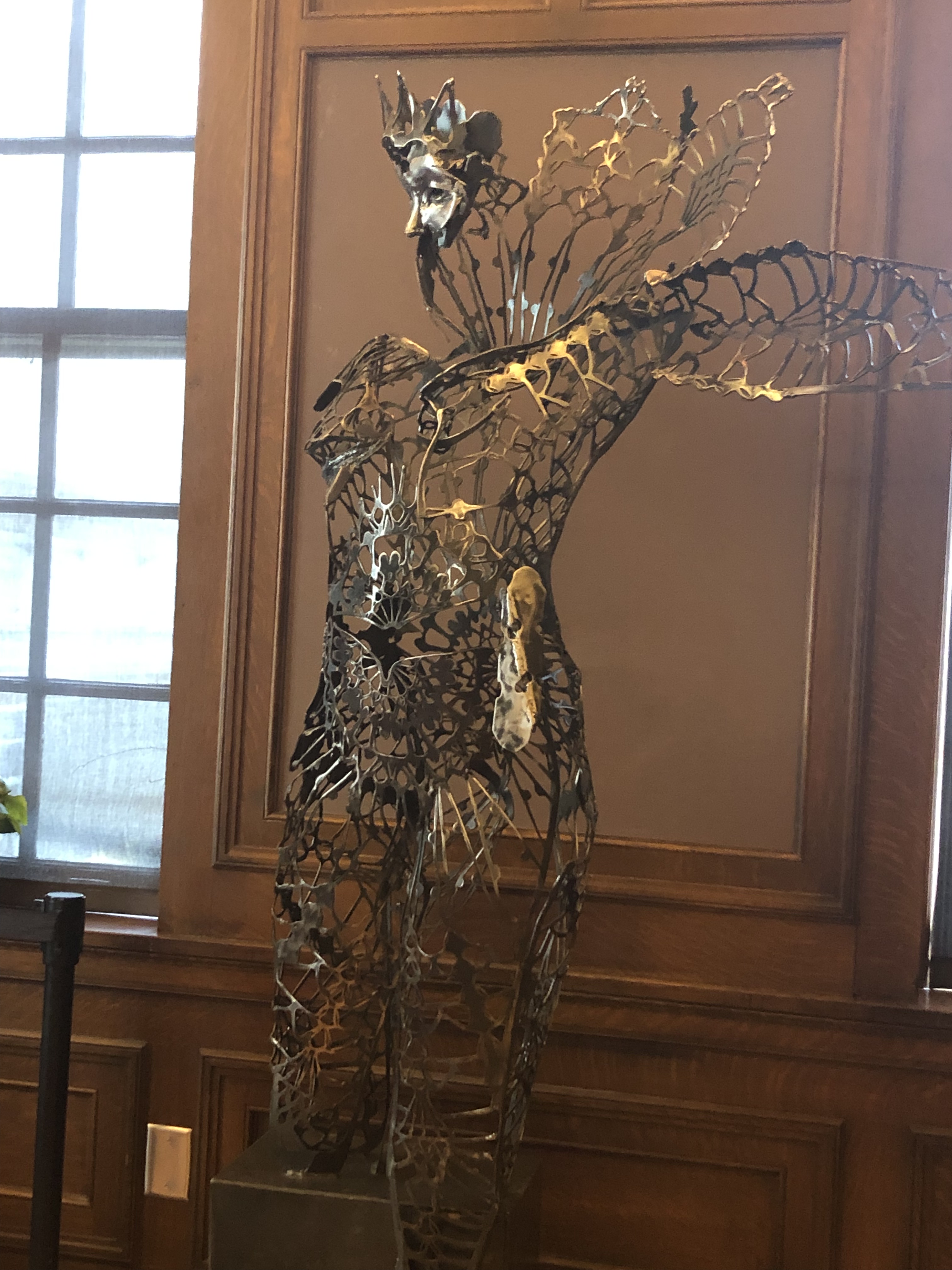
Earlier this week “The Monarch” was unveiled in the Hamel Browsing Library at the University of Wisconsin Memorial Union, placed there to honor the 150th anniversary of women receiving degrees from UW-Madison. What this living, woven being of metal and air will signify for us will be revealed overtime. This weekend as the Class of 2019 graduates, let the meaning making begin!
THE MONARCH. Artist: Victoria Reed. Gift of the UW-Madison Class of 2019
For me, the Monarch evokes strength, fragility, openness, and the readiness to fly. I sense the hard fought and unapologetic embrace of one’s own beauty, uniqueness, scars. I imagine resilience in the face of strong winds on what seems to be an impossibly long journey. I am reminded of how exhilarating and scary it can be to leave the places that you love. And the blessed possibility of return.
Perhaps this sculpture is speaking to me, or perhaps this incredible beauty is what I have seen in my students over the years.
Meanwhile, for all, and especially for the 2019 graduates, here is a closer look at “The Monarch.” I hope you have a chance to sit close for a while, consider the strength, marvel at the openness, see the possibilities, and contemplate flight.
4W stands for Women and Wellbeing in Wisconsin and the World and it is UW-Madison’s higher education initiative for gender equity and wellbeing. Our mission is to make like better for women, and, in so doing, make the world better for all. Our projects focus on women from historically marginalized groups in low-resource settings in Wisconsin and around the world.
Are we that group that is working to improve health care in Kenya? Yes! Working with artisans in Ecuador, Mexico, Nepal, and Kenya? Yes! Supporting women in science? Girls education? Gender and environment? Yes. Yes. Yes. And yes, we welcome both men and women and people of all identities to work with us….
The “better for all” phrase of our mission opens a door to a broad range of issues and to the possibility of a full and truly holistic feminist praxis – including all people, all species, all places, and our planet. Grounded in human rights principles, 4W works toward equal rights for women and girls as an end in itself, while acknowledging the life-sustaining role that they play in the continuity of families, communities, civil society, local and global economies, and the earth.
Simply put, 4W works to understand, reimagine, and leverage the unique role of higher-education for global change.
When you hear about the breadth of our programs – health care, micro-enterprise, addressing sex trafficking at home and abroad, collective translation of Latin American poetry, financial literacy, you might wonder how we choose them. How do they fit together? Will we do anything???
Well, we’d like to think we can do anything, but we don’t….
4W projects must meet three criteria: 1) they address a compelling need; 2) there is a UW leader and community partner who want to work together and 3) and there is potential for scalability and significant impact. We provide strategic expertise and financial support in the start-up phase –which might take 1 to 3 years- and then we work to sustain the program with appropriate scale and funding, and a fitting institutional home. We’d like to think that, in this way, we are transforming our world, and transforming our university, at the same time.
We have also established a small grants program with support from the Wisconsin Women’s Philanthropy Council-with two faculty awards and 4 graduate student awards per year, and an internship program, with about 10 internships. These activities offer professional and intellectual growth, increased social impact, and job skills for our faculty and graduates. We hope to double the grant awards and number of awards in the coming years.
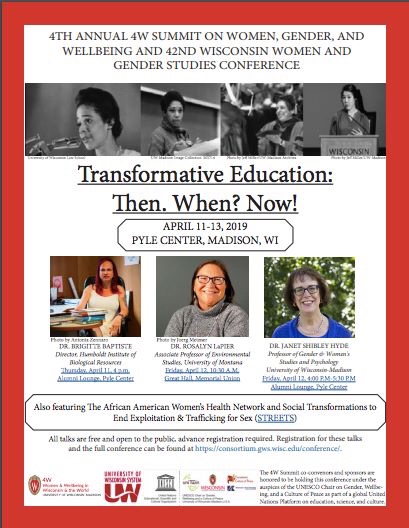
4W also hosts a robust series of events throughout the year. We have active 4W circles of faculty, graduate students, and undergraduate students. In addition to co-hosting the 4W summit and Gender and Women Studies Conference, we also host an International Women’s Day event, and a range of research to practice fora. We are proud that a UNESCO Chair on Gender Wellbeing and a Culture of Peace was awarded to UW-Madison!
During recent months members of the 4W leadership circle have been reflecting on the work to date and looking toward the future, asking ourselves what is next…. We want to do more, we want to do better, we want to be more inclusive and diverse, and we want to work with an intensity that matches the challenges that are before us. We want to focus on voice and leadership. Together, we’ll revisit important questions: What is feminist leadership? How can we practice it? How can we practice it better? And how can we practice it everywhere?
While there are many working definitions of feminist leadership, I’d like to recall the one offered by Gerda Lerner, a pioneer in women’s history from the University of Wisconsin. Lerner described feminist leadership as “…something that replaces and surpasses you, that has a life of its own because there are many people who will be drawn into it and who will give leadership to it … The point is that wherever we are as women, wherever we are situated in our lives, we can advance a feminist agenda if we stop thinking about how to be leaders and think rather about how to be doers.” (Lerner, 1995).
Many societal institutions are failing women right now, in fact, failing everyone. Leveraging the power of higher education for a better future, is powerful and possible and important. The 4W effort is unique at this time, but my hope is that this transformative work will become central and ordinary– business as usual – so that universities become safe places for everyone to learn, teach, grow and thrive. I’d like to see higher education lead, charting the course for real institutional change, so that other institutions can follow the example, and make life better for women, and make the world better for all.
Today I am honored to be invited to comment on “Transforming Leadership in Global Health” at the CUGH pre-conference session offered by Women in Global Health. I am looking forward to meeting new people and seeing old friends! It is a great way to get ready for International Women’s Day. I’ve been given two questions to think about- so I thought I would think out loud a bit here on my blog in preparation for the session.
“What is one piece of practical advice you would give to someone starting out?”
It’s hard to pick just one – there are so many practical things to be done! Learn to drive a stick? Learn to change a tire? Learn to speak three languages? Take a self-defense class? Always carry chocolate? Maybe you should buy that quick dry underwear and have the courage to travel with just two pairs… I have not yet done all of these things, and practicality is not my strongest suit. I am more of a dreamer with practical friends…. but maybe I can narrow things down to two essential, if not always practical, pieces of advice.
First, always pack a book.
And by that I mean make time for, brake for, reading and the arts. It is important to stay curious, take the perspective of others, keep learning, and hold space for the passions of your youth. In some ways that raw young being will always be your most authentic self. Remember her. This reading is a way to honor the roads you didn’t take — maybe that of a poet, or a painter or a comedian. (I know I have a rockstar inside, and yes, I let her out now and then…). The openness that results from this practice will enable you to let wonderful things happen in life and work
Everyone feels alone at times — on a team, during field work, forty-thousand feet in the air…. and women leaders are no exception. We feel alone, divided, overwhelmed, not up to the task. We carry an extra stone or two, and most of the water. Books can be friends who love you in these difficult moments. You can lose yourself in one, or find yourself in one, or write one yourself.
Second, always be yourself.
And continue to become yourself. Be brutally honest with yourself about who you are and who you are not. Be critical about your work, and use feminist approaches to help with that – develop embodied, dialogic, subversive and truth-telling practices. Smile and laugh and sing when you want — and please be stern and scowl freely too! And then try to be very gentle with yourself — I’ll even use the word tender — and go about the business of getting the work done. That’s what leadership is. Knowing what the work is, and getting it done. Be warned — if you are pleasing everyone you might not be doing very much…. you may have lost your edge, or you may be sacrificing the difficult truths in a way that is at odds with what transformative leadership should mean. Try to cultivate humility, persistence and hope along with some fierceness or fearlessness in yourself. It will be necessary and essential if we are going to create justice for women, foster human thriving, and ensure the survival of our earth herself.
“How would you catalyze change to create a better future?”
There are so many ways to make change. I don’t think there is one right way. Rather the future depends on everyone doing what they can, from where they are, and as who they are. While all the time cultivating trust in the world, despite the odds.
For me right now, leveraging the power of higher education for a better future feels powerful and possible and important. We have started doing this in a gender-informed way at the University of Wisconsin through a campus-wide, local to global, women and wellbeing initiative that we call 4W – Women and Wellbeing in Wisconsin and the World. Our mission is to make life better for women and make the world better for all. We focus on developing leaders, and we work to bring research to practice and practice to scale. It is a great model that can be implemented at Universities of any size. I think we are unique right now, but my dream is that this would become a very ordinary kind of program -business as usual – so that universities become safe places for women and everyone to grow and thrive and lead. I’d like to see Universities lead here, so that the many societal institutions that are failing women right now, in fact, failing everyone, can follow the example, and change, and make life better for all.
Many women in my life are sharing stories in personal conversations and on social media, about experiences of sexual assault. So I want to respond to those women here.
I am learning, or rather re-learning with renewed force, that Institutions like family, church, school, workplaces, neighbourhoods, and sports teams are simultaneously places where you experience love and safety, and where you experience these harms, mostly kept secret for so many reasons.
I am trying to believe that the vast majority of healthy males (80% or more?) enjoy and prefer consensual and mutual satisfying sex and would not be violent even if drunk. It’s not in them.
This reality (or what I hope is true) is obscured when a very harmful minority (could be as high as 20%- but I hope it is less) are capable of being sexually violent for sport – as a performance for each other. As a way of having fun at the expense of women.
This violent minority belong to every faith and no faith, every political party and no party, every race and no race, and they are alumni of every school we have loved (including my own Yale, Harvard, and UW-Madison) and no school at all.
While many do it as they struggle with addiction, others do it stone cold sober…. and laugh about it the next morning.
Some feel entitled, some live in denial, and others carry the memories of what they have done with shame – and maybe a never again.
Then there is a larger group – the majority of males who remain silent when they see harassment (from jokes to cruel remarks) or hear verbal disrespect and violent threats. By majority I mean not a vast majority -my estimate is that they are a simple mathematical majority – the 51%.
So that leaves a bunch of men – could be 49%? – who might just feel strongly enough about respecting women and all people – as beings entitled to bodily safety in their daily activities. And they think that we have the right to be as sexually active as we want on our own terms and always consenting.
Are they are willing to put politics aside and simply say “I believe all women deserve respect.”
“I believe all women deserve respect.”
I and many others need to hear expression this basic core value at this time.
Having escaped physical violence myself and recognizing my relative privilege I don’t often speak about, or let myself count, the number of times I have been threatened with violence. But this week I have been on the edge of making that list….The near misses, times I was naive but protected by someone, times I have made a clever escape. The stress related to the constant low grade vigilance that is part of the job of being a woman. The many times I just stayed home.
Anyway, and for the record:
I believe Anita Hill. (Always did!)
I believe Chrissy Ford.
I believe Debbie Ramirez.
…… And most importantly – today and every day – I believe the women from all the places and stages of my life who have told me their stories. At a kitchen table, in the back of a car, right after it happened, or years later. Or maybe there was just a simple “me too” on Facebook.
To all of you — you are beautiful and worthy of love and respect.
To all of you — you are beautiful and worthy of love and respect. The shame and blame belong elsewhere – with the perpetrator and with all who contribute to the culture of disrespect that made him feel entitled, that made him laugh at you, and that made him, and those around him, think that sexual violence is an acceptable normal and unavoidable part of becoming a man.
Convened by the School of Human Ecology, the Global Health Institute, the Department of gender and Women’s Studies, the UW-Madison has established the campus-wide 4W initiative, which aims to make life better for women and make the world better for all. Faculty-led action research at UW-Madison will result in measurable benefits in the communities where we serve as a partner for change. The program will focus on women’s health, leadership and wellbeing in private sector, government and civil society.
4W VISION
To achieve measurable improvements in women’s health, wellbeing, equality and empowerment, and, in so doing, to positively impact the quality of life for families and communities.
4W MISSION
To establish UW-Madison as a convener, catalyst and leader in advancing wellbeing and full participation of women in society. The 4W Initiative will support action research, train leaders, and provide a global platform for exchange related to research, policy and practice.
EXPECTED OUTCOMES
UW-Madison graduates from a broad range of fields will be prepared to serves as leaders in education, research and practice related to women and global wellbeing.
A variety of 4W programs will be realized within a holistic framework that emphasizes basic needs and human rights, thriving throughout the life cycle, leadership and empowerment, and the development of strong communities based on principles of eco-justice. These programs will develop and document best practices, and contribute to the spread of these practices through partnerships and outreach education.
The 4W platform for exchange will include an Annual Summit, policy forums, a website, and interactive digital engagement that will establish UW-Madison as a convener, catalyst and leader in relation to timely topics and major challenges related to women and well-being.
PROGRESS REPORT- May 2015
To date, this new program has successfully launched initiatives in: 1) health care, family planning and mental health, 2) working to end human trafficking, 3) micro-enterprise, 4) women and agriculture, 5) relationships and equality, and 6) engaging with the arts for wellbeing.
I am so proud to be leading this initiative! To learn more about 4W please visit https://sohe.wisc.edu/4w and follow us on twitter @4WMadison. I would love to hear your thoughts about women and well being. Feel free to comment below.
This morning I started my day an hour before class, at 8:30am. It was 15 degrees below zero, but that did not stop my global health students from stopping by to talk about joining the US Peace Corps. Later in the day Peace Corps Director Carrie Hessler-Radelet visited campus to announce that UW-Madison leads the nation in Peace Corps College Rankings, which answer the question “which University has the largest number of Peace Corps volunteers serving around the world in 2014.” Seems like a good time to give a shout out to some of our recent UW-Madison graduates who are serving in the Peace Corps around the world!
Readers may know Carybeth, Allison, Kevin and Monica. There are about 100 more Badgers out there! I invite readers to post pics and info about other UW-Madison PCVs in the comments, or send them to me at dipretebrown@wisc.edu and I will add them to the body of this post.
CARYBETH REDDY majored in agricultural economics (CALS), worked for the Global Health Institute, did an international internship in Ecuador, and helped us to launch our Wisconsin Without Borders Marketplace, which works to improve health and wellbeing through economic strengthening. She is currently serving in Cameroon.
ALLISON FEUERSTEIN majored in Biology (CALS), received a Certificate in Global Health and participated in the UW -Madison field course in Nepal. Before leaving for Nicaragua she took a graduate course relating to programs for orphans and vulnerable children to help her to better prepare for her Peace Corps Serice.
I first met MONICA RODGERS after I gave a lecture in a global health class she was taking. It turns out that I had served in the Peace Corps with her parents from 1983-1985! Monica received a global health certificate, and did her field work in Ecuador focusing on micro-enterprise and health. Here is is with her parents on the day she left for Peace Corps service in Peru. Two generations of Peace Corps Volunteers!
KEVIN KING majored in Neuroscience and did an internship in India as an undergraduate. This UW Mad Hatter is now serving in Azerbijan.
It was great to have Peace Corps Director Carrie Hesseler-Radelet on campus. In cased you missed here here she is, serving Peace Corps then and now…..
Thanks to UW-Madison students for inviting me to address the topic “Learning in Unexpected Places” at their November 23rd event. It gave me an opportunity to reflect about global engagement that I did in my 20s in Central America –work in an orphanage in Honduras, a war zone in Nicaragua and a water project in a remote rural community in Guatemala. Here is the youtube video and below is a text version of my reflections.
Start Small, Change the World
Today I am going to talk about changing the world. Perhaps I should have a narrower focus, and I did try, but I finally decided that besides saying I love you, or telling a really good joke, changing the world is probably the only thing worth talking about ever. Making change, addressing suffering, and mending the brokenness in our world should be what we dream about, and study, and talk about. With teachers, with friends, with colleagues. With people who are like us, and with people who are different from ourselves. Visions of healing, peace, joy and abundance should inform our lives.If you are a young person who has had the audacity and heart to proclaim to someone older and wiser that you want to change the world, you might have had some surprising, even discouraging, responses.
They might say, who do you think you are? What makes you think you or your ways are best? What right do you have to try to change other people?
Or they might say, Good intentions are not enough. A lot of do-gooders have been ineffective. Some have even done harm. They will tell you stories, mostly true, of unfinished schools, half-built clinics, latrines with holes large enough for a small child to fall inside, and other efforts that have solved one problem, while creating another. Worldchanging, as you have probably already guessed, is messy.
Another common response might be, There is plenty to do right here in your own community. This, of course, is very true. It is easy to be drawn to the drama, the exotic, the faraway places, and sometimes hard to remember that changing the world includes addressing disparities and injustice in your country or neighborhood. On your own street. We all need to visit the familiar places in our lives with our eyes wide open.
Then there is the predictable, Things are more complicated than you realize. What makes you think your simple fix-it scheme will work? Don’t you realize that the cultures that you think you can outsmart are hundreds of years old? Don’t you know that advanced study and assessment are needed before you can do anything at all?
You might be told that the abundant, sustainable life that you want for all people is just not possible! You are too idealistic. To accomplish what you are proposing would take generations. It is not possible to provide food, water, housing, education, and health care to everyone. It is not possible to live in a safe world where ALL people are free to express their identify and culture.
I can’t help but note that these messages about the impossible are spoken in a world that can distribute millions of Harry Potter novels in a single day; in a place where people think it is perfectly feasible to provide cell phones for everyone in the world; in a society where, in a given year, people collectively throw away enough food to satisfy the global food deficit.
Despite my refutations, though, the counsel you are receiving is valid. You must practice cultural respect and humility, embrace complexity, and consider the effectiveness, feasibility and sustainability of your efforts. I come back to these issues again and again in my global health work, and I find new mistakes, and new pathways to something better, every time.
I do sometimes wonder why we who mentor young people often start out with a long list of don’ts and cautions, instead of encouragement. I suspect, there is some generational tension here. Your hopes and confidence about what is possible remind us of all the ways that we, regardless of how much we might be doing, could be doing more. Your energy is wonderful. And terrifying.
You keep things simple. You ask simple arithmetic questions like “what if every student at our university sponsored basic needs for a child or family facing poverty in Milwaukee, Appalachia, Botswana, or India?” Wouldn’t that add up? What if I tutor a child or build a well, or provide a sewing machine? Couldn’t that make a difference? You use the sound and adequate arithmetic of a 5 year old, and it exasperates the experts.
Thankfully you persist. You are more globally interconnected than any previous generation. You are more able to embrace diversity. You are a generation of caring optimists. You are willing to try, take risks, ask questions, take responsibility for your mistakes, and try again. The truth is, you are better able to assess and predict what is possible than we are.
I would like to share some ideas about being part of change in our world. And this is where learning in unexpected places becomes so important. In my global public health work I have partnered with governments and NGOs, and mentored students in global efforts around the world. Today I will talk about my early global health experiences, work that I did when I was in my 20s, as many of you are now.
HONDURAS
In 1983 I left the United States for the first time. I join the Peace Corps and was sent to Honduras. My job was to provide counseling and support to teenage girls in an orphanage there. I lived with them, and also traveled with them to the villages where they were born to help them get their birth certificates. These journeys took me all around the country, on buses, in the back of pick up trucks and on foot.
When I think about the lessons from that time that might be useful for you today, one particular series of events comes to mind. I was having coffee one day with a Peace Corps friend who expressed concern that I was getting burnt out as a live-in counselor, and that I wasn’t really doing development work. There was no sustainability to what I was doing, she said. No multiplier effect, like when you train trainers, or provide seed to farmers, who in turn provid seed to others. I was mainly counseling, comforting, and refereeing the girls on chores. Kind of a gloried babysitter, really. It doesn’t sound like world changing, does it?
A few weeks later I was involved in a fair at the orphanage. We filled the dusty, colorless field near the children’s homes with games and fun for a day. The girls and I dressed up like clowns to entertain the younger children. By the end of the day I was answering to the call “Payaso, venga,” which means “Come here, Clown.” We had a piñata and candy. It was simple. A day at the fair. A magic day that we hoped the children would remember.
That night one of the girls came to my room to talk. Carolina sat down on my bed and said nothing, clearly on the verge of tears. I was sure it was boyfriend trouble again, and began to fill the silence with words of advice, solidarity, support, questions that might help her tell me what happened. “It’s not that,” she said finally. “I just miss her.” At 17 years old, after living in the orphanage for most of her life, she finally wanted to talk about her abandonment, and she had come to me. I felt so sorry to have gotten things so wrong, to have missed the obvious sorrow. I put my arms around her and she cried for a while, and I cried also. She did not expect me to do anything more, and I didn’t.
After she left, I sat alone in my room and thought about the words “multiplier effect” again. Suddenly I realized how arrogant and wrong that whole idea was. It implied that comforting Carolina, being a buffer against her sorrow for a few hours, was not important enough for some one like me to bother with. That a one to one return on investment was not acceptable when it came to the people like Carolina. According to the multiplier logic of international development work, the fun fair didn’t measure up either. Making joyful memories for children who had suffered so much? That was, at best, a loss leader.
I let go of wanting to do great things just a little bit that day. I realized I wanted to be a person who has the time and heart to do small things. The small things that justice, friendship and compassion demand. In this case I had not done the small thing particularly well, but I could work on that, I could keep trying. I hoped that meaningful change could come from this kind of engagement somehow. I took some comfort in arithmetic. After all, one and one does make two. That was certain, multiplication aside.
NICARAGUA
During graduate school I went to Nicaragua as part of a health and human rights research team from the Harvard School of Public Health. We were visiting a town in Chontales, which was as far into the war zone as we could go and still be relatively “safe.” We conducted a household survey to document the impact of the war on civilians. Things like disruptions to the health care systems, damage to schools, internal migration, and various negative health impacts. The results told the story that we expected, an important one, and we published them as planned.
For me though, the greatest learning occurred at the end of the interview, when I put down my clipboard and asked, “is there anything else you would like me to know.” Then I leaned forward and listened. I listened to what people said when they were free from the confines of structured questions and coded answers. When the clipboard was not creating a small barrier between us. They told me stories about how the war had affected them. They talked about their fears and their hopes. They talked about how they might solve problems in relation to food, shelter, and getting the kids back in school somehow.
During the course of the interviewing we came to a house that had all the windows and doors shut, even thought it was the middle of the day. I wasn’t sure if I should knock, but I did, and Juana and Fidelia, two sisters who lived together there let me in. After the survey they told me their stories. Juana spoke briefly and calmly. She was married to a Misquito Indian. He’d been a miner, but was now working as a day laborer. They were relocated by the government because their town was unsafe for civilians. Her home was in a war zone. Violence or the threat of it was everywhere. She looked over her shoulder when she washed clothes or when she walked upright in the quiet fields. She heard gunshots in the morning. Her sister Fidelia had a thin face and urgent speech. She began to speak each time Juana paused for a moment. It was sometimes hard to keep track of who was saying what. Fidelia, a widow with eight children, had lost her husband when he was killed at a family party on their farm, along with nine other men and a woman who tried to defend them. Fidelia began to list the widows and count the orphans — 34 children in that small village had lost their fathers, a while generation of men were lost, she said. Because of what they had been through, Juana and Fidelia were often afraid to speak out, but they wanted to tell me these things. They wanted me to know, and they wanted me to tell someone else.
Research is an important tool for changing the world. I knew that before I went to Chontales. But what I didn’t expect, was that the fact-finding survey that we had worked so hard to design would be the lesser source of information for me. I learned about the importance of story, witness, solidarity, and hope.
GUATEMALA
A few years later I found myself in Guatemala working with CARE to develop a monitoring system for a water and sanitation program. This took me to a remote village in Quetzaletango, to see the newly installed well.
We set out at sunrise (seemed earlier) and drove until the road ended. A simple meal awaited us there — blue corn tortillas, beans, sour cream, and sweet coffee in a tin cup. I am not sure if it was the early morning air, the hospitality, or the food itself, but I still remember this as one of the best meals of my life. Then we hiked up to the village through the beautiful sparsely inhabited terrain. We came to a river that had to be crossed on a walking bridge. It was just a plank really, the width of a log with no rails. Everyone in our party crossed with ease. But I made the mistake of looking down, I hesitated, and then my anxiety spiraled. I was sure I would fall from this balance beam bridge down to the water below. I stood there frozen on one side of the bridge, with the rest of the team on the other. A local woman happened to be coming up the path on the other side. She smiled at me reassuringly – she did not speak English or Spanish, and I did not speak her language, Mam. She looked to be 5 months pregnant, but she crossed over the bridge and extended her hand to help me cross. Her kindness enabled me to look straight ahead and cross the bridge. I am not sure what I would have done without her help.
When we arrived the villagers were assembled, waiting for us. We sat in a circle and they told us about the water project. Until that moment I only knew that CARE had provided materials and assistance with building the water tank. As the head of the water committee told us the history of the project, I realized the extent and intensity of the community effort. What the NGOs called “the local contribution” included working with government over months to procure land rights to the site of the well. It involved carrying every brick, and all other materials, up to the village along the route we had just hiked. It included building the water system, building the latrines, and deciding who would do extra work on behalf of the widows and the elderly who could not do their share.
The lessons of that day in rural Guatemala have echoed again and again in my work. Communities are full of energy and desire for change. While outside assistance can be useful, if we look honestly at our successes, our contributions are always small when compared to the efforts and contributions of partners, local leaders and community members. We who have the privilege of crossing worlds are constant recipients of hospitality, assistance, we are accommodated in ways that we don’t even see, and, mostly, we are treated with kindness.
As you can see from these stories, learning often happens in unexpected places. In the background. On the way. While we are supposed to be paying attention to something else.
There is one more unexpected place that I want to mention. That place is honest reflection in a quiet room. Reflecting in silence, writing in a journal, taking the time to savor and more deeply understand your experiences. Honoring relationships with remembering, and being as honest with yourself as you can. This “unexpected place” is where we learn to live more, love more, risk more, and laugh more. This is where we change ourselves.
So you want to change the world. You want to live the selfless intimacy, the giving, the solidarity, the friendship. I say go for it. Dream about it, study it, talk about it, and most importantly, take action. Personally, locally, and globally. Sing all the songs while you are young, in as many languages as you can.
But go further. Do more than change the world. Have the courage to work very very hard, for small things that you can change. And do this every chance you get. Have faith in others, have faith in the future, have faith in faith itself, if you can. And when having faith is hard, do the math. If you have trouble with the math, ask a five year old for help.
Small changes are big. They move the frontiers of what is possible – they are the galvanizing force behind big important changes. Acting in this way will align your values with who you are in the world, and you will end up being part of change in bigger ways than you ever imagined. Start small. Change the world. And let the world change you.
Welcome back from Ecuador, Mexico, Guatemala, Colombia, Togo, Rwanda, Sierra Leone, Uganda, Kenya, Malawi, Ethiopia, Nepal, Germany, Sri Lanka, Cambodia, Thailand and Vietnam — not to mention those of you who explored the global dimensions of improving health and well-being right here in Wisconsin!
After classes ended in May, nearly 200 of you set out to expand your understanding of sustainable global health and well-being. You engaged as learners and change-makers with communities around the world. It has been great running into you and hearing your stories on the Lakeshore path, State Street, coffee shops, and the library (really!) — a special thanks to those who have stopped by my office to share!
This year I will be blogging about field work, fall courses, global health networks, and books related to global health. I would also love to feature YOUR WORK as your global health projects and ideas develop.
My travels: In ECUADOR I will be teaming with Instructor Janet Niewold to work with the Sumak Mayo women’s group on a women’s micro-enterprise and health project. The women are selling jewelry and scarves, and are hoping to develop an eco-tour that highlights their rich indigenous culture. In ETHIOPIA I will be continuing to collaborate with leaders on Quality Improvement in Emergency Medicine, and I hope to expand the effort to have hospital-wide impact. There are many other broad-based initiatives going on in Ethiopia with leadership from Dr. Girma Tefera, Dr. Jonathan Patz, and Heidi Busse, MPH, so I hope to blog about their efforts as well. Finally, I will be going to MOZAMBIQUE for the first time, to work on quality improvement in the pediatric department of a large public hospital. If you see me between campus listening to a WALKMAN don’t worry, you have not slipped through a time warp into the 1980s — I am making use of my vintage equipment (cassette tapes!) to brush up on my Portuguese.
Books Related to Global Health: I will be reviewing a mixture of fiction and non-fiction related to global health. I’ll be covering a pair of South African novels, Ways of Dying by Sakes Mda and Disgrace by JM Coetzee, which I read during my recent visit to South Africa. I’ll review Strength in What Remains, by Tracy Kidder (of Mountains Beyond Mountains fame) and I also have Inferno, by Dan Brown, on my desk. That is about the World Health Organization – should be fun. Of course I will cover this year’s UW-Madison GO BIG READ, A Tale for the Time Being by Ruth Ozeki. Also on my bedside table is La Linea by Ann Jaramillo and What is the What by Dave Eggers. If you have books to suggest please post in the comments section and I will add them to the list, and maybe even review your suggestions first.
Global Health Networks: I will blog highlights from my reunion at the Harvard School of Public Health, where there will be some workshops and lectures on leadership, and the American Public Health Association — the theme this year is Global Health. I will be participating in an Roundtable on Inter-professional Competencies with a network of other universities –the concept note that I will present draws on insights from the global health teaching and lecturing that I have done at UW and at John’s Hopkins University over the past 20 years. Also, I will be presenting a “TED talk” at a Conference related to Care for Orphans and Vulnerable Children in April — so I will blog or tweet items of interest.
Teaching: This semester I will be teaching Foundations in Global Health Practice for graduate students in the health sciences, and a new course, with Professor Nancy Kendall, entitled Education and Global Change. I’ll also be doing grand rounds for the OB/GYN department, and preparing a workshop session for the residents at UW hospital. These will be highly interactive sessions, and I will share key resources and insights here.
GUEST BLOGS: I welcome these from all of you! Please email your global health reflection with 1 or 2 images that go with it to dipretebrown@gmail.com. and I will contact you about next steps.
GH Student Mailbox: We have had some amazing email exchanges about your field work. I am going to share some of these as blog posts (making them anonymous first) from time to time — so that by “reading each other’s mail” and sharing comments, we can all learn more about Global Health.
On September 22nd, after 3 years of writing about it, talking about it, and trying to walk the talk, my UW-Madison colleagues and I launched our global service learning program, Wisconsin Without Borders. What’s the big deal, some might say. Aren’t their already Doctors without Borders, and Engineers without Borders? The answer is yes. There are also teachers, lawyers, architects, nurses, sociologists, builders and acupuncturists. I had planned to end this post with the idea of starting a Clowns without Borders, but they are already active, spreading laughter and joy. And the Knitters without Borders are making blankets and sweaters and sharing their dyeing and design techniques. I tried everything to find a new idea, but struck out again and again….Bloggers, Dentists, Geeks, Monks…they are all out there, without borders. I stopped playing fair when I found a web reference to Mariachi without Borders! Cynically, I searched for Fence Makers without Borders. That would reveal the hypocrisy, show that the term was losing its meaning, would it not? But the Without Borders world held, there are no Fence Makers without Borders, at least not yet….
Why do so many of us want a Life without Borders? What are we trying to say about ourselves? Perhaps simply that we are open to the world. We like to travel. We want to make a positive difference in the world, to be part of the solution, at least for a moment. But there is some kind of poetry at work here also. The phrase evokes the wild beating heart, a sense of freedom, sunlight, a loosening of chains. It expresses a desire for union with people who are different from us, it says we are willing to risk ourselves to explore the differences, celebrate them, and watch them dissolve.
Even now, when there is so much need for healing in our own communities, my students and colleagues and I are finding a lot of support for the idea that reaching beyond the boundaries of our state is both a duty and a privilege. Our students can be global leaders, they can act both locally and globally to promote justice, human flourishing, and care of the earth. Our event featured 13 projects from around Wisconsin and the world that are inspired by the “Without Borders” spirit. Posters can be viewed at: http://centerforglobalhealth.wisc.edu/389.htm
You can see my brief Intro Remarks Explaining Wisconsin Without Borders (Hi Mom!):
The program also featured remarks by John and Tasha Morgridge, who have generously supported The Morgidge Center for Public Service for the past 15 years, and Bob and Sara Rothschild, who presented their work in Botswana, where they are working with communities to build public libraries. Their presentations and the entire event can be viewed at http://www.youtube.com/user/MorgridgeCPS











 Reflections